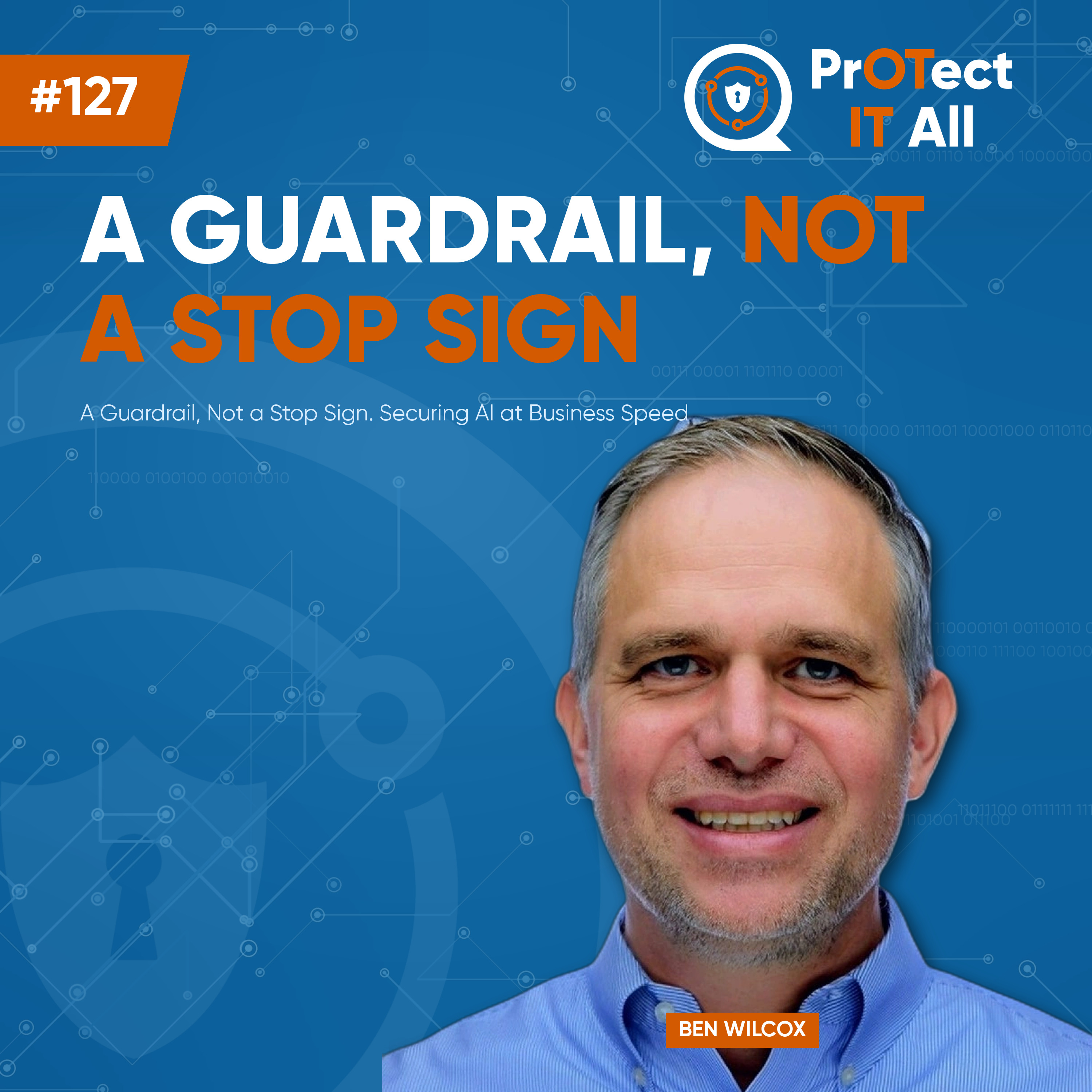
Episode 127
Interview
Work with Aaron: https://protectitallpod.com/work/
The book: https://protectitallpod.com/book/
This episode: https://protectitallpod.com/ep127/
The OT Security Starter Kit: https://protectitallpod.com/starter-kit/
Three months ago Ben Wilcox's company was running roughly 200 AI agents. When he checked the day before we recorded, it was 900. Nobody stood them up on purpose, and every one of them runs under somebody's identity.
Ben Wilcox is CTO and CISO at ProArch, which means he carries both sides of the argument: the pressure to adopt AI and move fast, and the job of answering for identity, governance and compliance when the moving fast gets ahead of the preparation. Most conversations about AI risk are one of those two people talking about the other. This one is held by somebody who cannot pass the problem across the table.
His position is not that AI is dangerous. It is that AI security does not start with securing the model, it starts with securing the environment you drop the model into: identity, access, data scope, logging and ownership. All things security teams already know how to do.
Ben Wilcox is the Chief Technology Officer and Chief Information Security Officer at ProArch, a global technology consulting and services firm specializing in cybersecurity, cloud, data and AI, and software development. With more than 25 years of experience in technology, Ben has led enterprise architecture, cybersecurity strategy, regulatory compliance, incident response and large-scale business transformation initiatives. In his dual CTO and CISO role, he helps organizations balance innovation with security, evaluating emerging technologies from both a business and a risk perspective.
Learn more about PrOTect IT All:
Work with Aaron: https://protectitallpod.com/work/
The book: https://protectitallpod.com/book/
This episode: https://protectitallpod.com/ep127/
The OT Security Starter Kit: https://protectitallpod.com/starter-kit/
YouTube: https://www.youtube.com/@PrOTectITAll
Email: [email protected]
X: https://twitter.com/protectitall
Facebook: https://facebook.com/protectitallpodcast
To be a guest or suggest a guest or episode, email [email protected].
Please leave us a review on Apple or Spotify:
Apple: https://podcasts.apple.com/us/podcast/protect-it-all/id1727211124
Spotify: https://open.spotify.com/show/1Vvi0euj3rE8xObK0yvYi4
Aaron Crow (0:00) Thank you for joining me on another episode of the Protect It All podcast. I really love these podcasts. I love all of them, but there's so many times I'm talking with friends, people that I've known for decades, all that kind of stuff. It's really exciting for me to talk to new people, people that I haven't run across, to hear new stories. And that's the point of this podcast, and to get more and more folks, more knowledge, more use cases, more experiences and hear so I can learn, so the audience can learn. So with that,
Aaron Crow (0:27) Ben, thank you for joining me today. Why don't you introduce yourself, who you are, background, all that kind of fun jazz that you want to share with the audience?
Ben Wilcox (0:34) Hey Aaron, appreciate you having me on. Ben Wilcox. I am the CTO and CISO for ProArch Technologies. We're a Microsoft centered partner that helps organizations move from data to insights. And so kind of think about what does that mean? It means we help lay that secure foundation for data and then take applicable insights, whether that's analytics or starting to leverage it for AI use cases.
Ben Wilcox (1:02) and all the things that go in between, because AI is not just one single kind of model these days, right, that you're doing. It's an entire approach. It's cross team oriented, right? You have to have SMEs from lots of different areas, infrastructure, data, AI, security, right, to be able to do this appropriately. So my role there specific at ProArch is to kind of be at the intersection of business adoption of the technology.
Ben Wilcox (1:31) But also being that guy on the other side that says, this is what happens when it goes wrong. So we need to be able to do it fast, but we need to be able to do it securely. And that's kind of my responsibility here.
Aaron Crow (1:43) You know, it's funny, I talk about it a lot, but I've been a vendor, I've been an asset owner at a company, and all the different things. But so many times we're focused on the term left of bang. I'm gonna try to prevent things from coming in, firewalls, prevention, and we should absolutely do all those things. But sometimes we seem to focus almost exclusively on I'm gonna stop bad things from happening.
Aaron Crow (2:10) And I don't put enough effort around what happens with something actually bad does happen and how am I going to recover from that. And this is what I talk about all the time. Bad doesn't necessarily mean a nation state is attacking you and you have malware. Bad can be Bob misconfigured something and now my entire environment is broken and I have to fix it.
Ben Wilcox (2:27) Sure. A hundred percent. We do a lot of work in like manufacturing and energy and stuff like that. So when I think about what you just described, I think about resiliency, right? How do we ensure that the environment is resilient and operating so we can keep going? So a hundred percent, right? Stuff does happen and you can't stop at all. So
Ben Wilcox (2:47) What do we do to recover? Right. What do we do, do we have the right information? Do we have the right procedures? Do we have the right technology in place? And does it meet the business objectives, which is usually the missing link? What I find there is like no one's had a conversation about the business piece yet.
Aaron Crow (3:04) Well, and that's why we're here. Like for the longest time, technology the tail that wags the dog, right? We have this big budgets, we've got these giant teams, but technology only exists to enable the business. Cyber only exists to enable the business.
Like if we get out of the understanding that none of this matters if the business doesn't function, and our whole purpose in existence is to support the business function. It's all about making it more efficient, more capable.
Aaron Crow (3:32) Higher ROIs and lower risks and all those types of things, but it's all about the business. It's not about the tech stack.
Ben Wilcox (3:39) Right. And it's not necessarily someone pointing a finger at you either. With, you're saying, hey, this is something wrong, right? This is something we need to. I see a lot of defensiveness on both the security side and the tech side of people that are enabling technologies when we start poking and prodding into, hey, why did you make this decision? Right? What's the reason behind your, or hey, this doesn't look right, we probably don't want this variable in here with this information.
Aaron Crow (3:42) Right.
Ben Wilcox (4:07) Right, this is a plain text. Why is it there? So I love to see businesses and technologists and security professionals all starting to work together and trying to find what it is that will help the business be successful and be its best.
Aaron Crow (4:26) Yeah. Well, and that's why many of us at least started. Obviously a lot of people get into this because you can make money and there's nothing wrong with those things. But a lot of us got into this because we like solving problems. And a lot of us got into this because we like solving problems, we like to make good money, and also we're passionate about fixing things and protecting things and making sure that these businesses function, right? And that's one of the reasons why I'm so passionate. It's why I do this podcast, it's why I have awesome conversations with folks like you.
Aaron Crow (4:55) It's because I want to make sure that it's protected. I want to make sure, and when I protect it, again, I don't just mean cyber, I mean the whole process in the end. When I walk into a facility, whether it's a manufacturing facility or a bank, I just want to look at it and understand where are the risks, where's the value, and how do we protect the crown jewels of whatever this company is and make sure that we're putting systems and protections around those things and thinking about it of.
Aaron Crow (5:22) Hey, what's the bad thing that can happen? And how do we start thinking about how do we protect it, monitor, recover, all those really control frameworks that we're looking at around all those different attack vectors and responses, et cetera, right?
Ben Wilcox (5:38) It makes a lot of sense. I'm curious, like where do you see the risks people are ignoring today that they really shouldn't be ignoring? Because I'll share my insights afterwards, but I'm kinda curious of where you're seeing them at this moment, because the world changed so fast if we look at the last couple of years, right? And
Aaron Crow (5:48) Yeah.
Aaron Crow (5:58) I think the problem I see, I mean it's so big, right? We have exacerbated the problem. We've made it bigger, we've made it faster because of AI. And AI is making problems in our data exfiltration, making problems in our business processes, making problems with everything that much worse. It can also be a positive, because we can use those same tools to help clean things up and make them more efficient and capable.
Aaron Crow (6:26) But unfortunately, I fear that so many organizations are not understanding their total business process. So they don't know where the things are broken and where the crown jewels are, effectively. And unfortunately, many times from my experience, they don't necessarily find them until it breaks and it stops working. Or Bob leaves and I can't fix it and we're trying to resolve something and nobody knows how it all goes together.
Aaron Crow (6:53) Compound that with AI on top of it and that can mean a bad, bad scenario. Like you're playing with fire and you're surrounded by gasoline. Right. And if you do it carefully, you can do it, but man, it's dangerous.
Ben Wilcox (7:08) You gotta make sure you're not dropping your match anywhere right nearby. You're holding it up high and hoping the fumes aren't gonna bring it back down. No, I completely agree with that analogy, because I was thinking about specifically today, like there's a bunch of business processes that wanna be enabled from an AI perspective. And then you got these legacy platforms that really aren't designed, you know, they have older APIs, things that are, you know.
Aaron Crow (7:12) Exactly.
Aaron Crow (7:17) Yeah.
Ben Wilcox (7:39) put in place, you know, REST APIs, they're 10 years old. They don't, maybe they're not also very thorough. They don't have like really granular things with you being able to delegate permissions and identity access controls, right? And you're accessing this one legacy platform with an API key. Now you have to set all these other restrictions on here and you're expecting your security controls
Ben Wilcox (8:04) to somehow be managed by an MCP server or something else in the middle here, because your end system where all of your crown jewels are isn't capable of doing it. So you got some middleware somewhere else that's handling it. And what if that thing goes wrong? Right. And now that's, you know, or all this open source stuff. A lot of people are bringing in MCP servers from the internet and turning them on in their environments and they're sitting locally in systems or, you know.
Ben Wilcox (8:33) spun up in the cloud and you have zero visibility into these things. And there's all of these little pieces where if you're not tracking your entire business process, and the security team isn't upskilling their understanding of how AI is being built, you're never even going to surface these risks as a potential problem out there. It's a challenging era to be in security, thinking about your profession of where it needs to go.
Ben Wilcox (9:00) and trying to mitigate the risks that are out there in an era where technology really hasn't even completely caught up, right? We have some of the tooling. We don't have great tooling in the way that the businesses want to enable AI today.
Aaron Crow (9:10) Yeah.
Aaron Crow (9:16) Well, and that leans me to another problem that I really see is, for years we looked at products and services and solutions. We would go to, there's a reason you go buy commercially off the shelf product. You're going and buying SAP, you're buying these large scale products and capabilities. It's because of the support. It's because it's been put through the rigor.
Aaron Crow (9:44) Now I fear a lot of organizations are going to do, well, we can just AI code that. We'll build our own in-house. We'll just build a custom product that fits exactly what we want to do. And I remember a use case specifically way before AI, but we used an EAP process and it was a product called Maximo. And it was designed for power utilities. And it was an IBM product, right?
Aaron Crow (10:06) Well, we had gone from mainframe. So we went from a mainframe process and brought it into Maximo. And we ingested all the mainframe things into Maximo. The problem was is that we built all of this custom logic outside of Max, or in Maximo, but in-house. Like we built all this logic and if-thens and all this different stuff, custom code. The problem was is now we have this product that is no longer, it's a Frankenstein.
Aaron Crow (10:33) Right. So we can't upgrade to the next version because it'll break everything. Like nobody really understands how all the pieces are tied together. So we got to this place where it was better for us and cheaper to actually do a complete migration to a brand new off the shelf Maximo solution and migrate our data and go into standard off the, you know, off the cabinet.
Aaron Crow (10:59) Processes, procedures, et cetera, that come from Maximo built in, than it was to upgrade what we had, because we knew it was going to be so painful. Right. So, and that was a multi-year, multi-million dollar across multiple environments. It was a painful, painful process and super expensive. And it was all because we didn't, they didn't think when they did this, it was like, yeah, it works great. And it did until it stopped.
Aaron Crow (11:25) Right. And that's one of my big fears with AI, beyond the cybersecurity and the data exfiltration and all that kind of stuff. It's the supportability. Like, yes, I can spin up an MCP and I can build up a product in a day. If you know what you're doing, like somebody like me and you, I was a CTO. I know how to build things. But do I want to put the thing that I build into a Fortune 100 company to be their process that they're depending on?
Aaron Crow (11:54) No. Does it work in my home lab and grow into my household? It's perfect. It does a great job because I can support it. And if it breaks, I'm the one that's mad.
Ben Wilcox (12:05) And what are the implications of that, right? So you go away, who owns it now, right? Now you got this piece of code running under someone else's identity. I was just looking at, I've been kind of following the trends of agents deployed in our environment. And like three months ago, I think there was roughly like 200 agents. I just looked yesterday and we are at 900 agents.
Aaron Crow (12:11) Right.
Ben Wilcox (12:34) In a very short period of time. And so like this is people just spinning up their own stuff, right? Some of these are very simple agents, right? They just have a knowledge source and they're chatting. Others are going much more complex.
Like I'll give you a funny example. Back in December, we had a, I got a request for an API key for our CRM by an account executive.
Aaron Crow (12:41) Yep. Sure.
Ben Wilcox (13:03) And I said, this is a first, right? I've never had an account executive ever tell me, hey, we need an API key for the CRM. And I'm thinking, do they even know what they're doing here? And so I called them up and I said, what are you doing? They're like, I'm just following the instructions on Copilot over here because I'm trying to build an agent. And I want to connect it into the CRM to be able to extract information that I can do my job better. And like
Ben Wilcox (13:32) they're trying what they want, right? I'm like, I'm sorry, I can't, I gotta deny this piece, but we'll figure out a longer path for you to get to where you want to go. So the innovative side of AI, I love it for the business, right? It's getting people thinking about it that maybe have never been enabled in this type of thing. But unless we're giving them a path and saying, hey, these are the rails that you need to be able to go on so you can get access here, right? Like
Aaron Crow (13:47) Yes.
Ben Wilcox (13:58) IT and security have to start standing up those paths and saying, hey, this is the way you're gonna do it. Because you know what? When you go away and this agent is in use by the entire sales team, who's gonna own it? Is it me? Is it IT? Is it someone from your team? So we gotta figure out all these things, and having new discussions are great conversations to have, but they're discussions that the business needs to take forward and really think about how do I enable it so you know.
Ben Wilcox (14:27) democratization of AI is really the holy grail I think for a lot of companies, but you gotta do it safe. And you gotta be able to have some visibility and continuity beyond a single person.
Aaron Crow (14:40) Well, absolutely. And you said a lot right there, right? Is we've got to be able to enable our staff to think through and R&D. I mean, you're basically talking about fast tracking R&D, coming up with use cases. But just like when I was a CTO of a software company, just because it could work and just because maybe it's a great idea doesn't mean that I do it. Right. There were a lot of great ideas that we didn't do and we never got
Aaron Crow (15:08) even put into a sprint to be created in the product. And it wasn't because it wasn't a good idea. It wasn't because it wouldn't have worked. It was because of a number of other factors that had nothing to do with either of those things. And if your sales guy is, no offense to sales guys, but if your sales guy is coding and building products against your things, that can be a problem. But on the flip side, if we just say no
Aaron Crow (15:35) then these people are going to go do it on shadow IT, shadow AI, whatever you want to call it. They're going to do it on their own and just not tell you about it, right? You know, obviously where there's an API integration, they'll have to do it, but there's workarounds and we know that. So people are doing this on their own. They're using Claude, they're using ChatGPT, they're using whatever.
So we need to, I believe we need to have sandboxes where people can create things, but it needs to have some guidelines and some criteria around those things before it gets moved into a production
Aaron Crow (16:04) you know, kind of environment, and there's some kind of, I don't know, CAB, some kind of, you know, acts approval board and architecture review board, some kind of something that people are thinking about. And who is that champion? Right? Cause you don't want to stifle thought and creativity, and but you also don't want to be holding the bag of five hundred and seventy four applications that nobody owns and now you do.
Ben Wilcox (16:30) Yeah. Like I remember hearing an analogy from one of the Microsoft security leaders a number of, maybe it was like two years ago or something like that, where they were going through and doing all this cleanup, right? Because they had just gone through this security exposure where one of the nation state actors got in through an old app and this app had
Ben Wilcox (16:59) had access to keys which granted access into some customers tenants because it had API keys in there. And then those threat actors went in there and basically ransomed that. So they were going through and disabling their old applications, and there was millions of apps that had been built with, on, in Entra, right, from this identity perspective. But no one was owning it. Right. And so
Ben Wilcox (17:25) At the end of the day, someone had to own that and someone has to own the governance around it, the life cycle of it, and how long is this thing gonna be around for? And if it's not being used, right, let's get rid of it. Or who's evaluating the permissions, right? Do we still need these high permissions on here that are granting overly excessive permissions? Because hey, that's an easier thing to do. I've had numerous conversations, because developers want to develop, right? And they want the
Ben Wilcox (17:55) They're gonna find the easiest way forward, right? Hey, if it says I can get everything that I need with some permission that says all on it, hey, that sounds good to me, right? Like I don't have to go be super granular and I don't have to go figure it out and try to make all this a much harder thing than it needs to be. But someone has to have those conversations and say, hey, this is acceptable and this isn't. And we gotta set that governance and cleanup.
Aaron Crow (18:20) Yeah. Yeah. And it all goes back to people, process, and technology, right? Is the technology is great. It's there. It's gonna be life changing for sure. It's gonna change our industry. It is changing our industry on a daily basis. But when you get into that, we've already seen multiple examples where AI gets out of its cage and it does things that nobody asked it to, or maybe they asked it to, but they gave it guidelines or guardrails.
Aaron Crow (18:49) And it jumped those guardrails, right? There, they're the Hugging Face and other examples. We don't know what's happening when these MCP servers are running. Like there is no person there. We don't have full visibility into what's happening. It's just going and doing things and coming back at a response. We don't know every step it's happening, right?
So we give something an API key, and then somebody else has an API key, like you have an API key running on something else. Well, my MCP that happens to be running.
Aaron Crow (19:18) in the same network, maybe it jumps over and asks you and then you give it to, like we don't know the things that are happening behind the scenes and we have to protect it because we have to assume worst case scenario, right?
It's just like when I'm designing things in a cyber, in a security way. I have to assume the absolute worst case scenario is that this is going to happen and you're going to give me the bad information and then I'm going to have that access. I'm going to be able to pivot and then I've got, I'm three seats down the wind and bad things happen.
Ben Wilcox (19:24) Right.
Aaron Crow (19:47) Right. And that's where we just don't have enough. We're so early in this AI game. We're running this path of I have to go really fast because I want to innovate, but I gotta hold it back a little bit because I don't want to give it to the keys of the kingdom, because I'm terrified of what that can do and how bad it can. Again, I'm standing around, I'm holding matches and I'm surrounded by gasoline.
Ben Wilcox (20:10) Right. Well, the pieces there of being scared, like we should be scared. Like this summer has shown us that these AI models are completely capable of doing crazy hacker things, right? At a speed that we can't even contemplate. Like these things are running in hyperscalar data centers and, right, who knows how much compute power that they were testing this stuff with, but
Ben Wilcox (20:38) Right? These data centers have terabytes of bandwidth. It's not like we're sitting here with a hundred meg connection or a gig connection even. Like these things have memory compute and they can go fast and they can do all this stuff at machine speed. And we're supposed to have defenses at machine speed. Of what capacity, right? You think that your SaaS security vendor is giving you enough compute power to handle going through this stuff at that fast of a capacity?
Aaron Crow (20:52) Yeah.
Ben Wilcox (21:06) No, they're not, right? We're gonna be trailing behind here. So kind of circling back to where we started this conversation, I think you were saying, right, what's the worst case scenario, right? We gotta understand that blast radius of there.
And so I think as we start moving forward, the architecture we're gonna start seeing is pockets, right? This is the pocket here, and segment it, and maybe we're gonna get back to a point where there's physical segmentation, not just logical segmentation in the future, for really critical stuff like
Ben Wilcox (21:36) It might be going backwards a little bit. I don't know. If it's really sensitive, it makes a whole lot more sense. You can physically see it, right? Logical stuff, maybe there's still a bypass there. I don't know.
Aaron Crow (21:47) Yeah. Well, I mean, there's a reason why in critical infrastructure and OT many times our architectures are more archaic. They're more physical segmentation. I'm not using VLANs for segmentation. I've got a different firewall in different areas. I'm having to go through multiple hops to get into these environments. I'm not allowing access directly. I'm using older protocols. I'm doing different things. And, you know
Aaron Crow (22:17) On one side, there's risks to that. Obviously, it's complex. It's more expensive than it is doing it in a virtual, you know, I can have one firewall and I can split up hundreds of environments, or I have to have 50 firewalls, physically separate firewalls. And obviously, there's an expense, there's a complexity to that. There's wiring and hardware and failures and power supplies and overall power usage, like all those things are factors. But in critical processes,
Aaron Crow (22:46) I don't care. Right. It's better and more reliable to do it that way. And I want it to be difficult to get to. Like I don't want it to be easy to gain access. I want it to be, I've got to get out of my chair and I've got to go over.
Like there's a reason why, if you get into defense or government contract type work, there's a reason why I can't do it at this computer. I have to go to that computer. And they're physically separate computers, right? Could I do it from this computer? Sure. There's no reason we couldn't connect those networks.
Aaron Crow (23:16) They know that that is a risk, right? And that's a way that they get around that is you can't do it from here. You physically have to go over there in a different room. Maybe it's in a SCIF, maybe it's in a different building. Like there's reasons that physical segmentation is there.
And of course, you don't do that for everything, but those critical processes, and that gets back where you first started, where we had this conversation, is understanding what those critical crown jewels are in your environment and what are the things that you should be a little more stringent on.
Aaron Crow (23:43) Like maybe I'm gonna allow you to look at the CRM, but you're not getting into the accounting system. Like maybe you can get into the SharePoint, but you're not getting into the employee, you know, Active Directory. Like I'm not doing an MCP server to Active Directory. No, it's just not gonna happen.
Ben Wilcox (24:03) In those instances, you look at the MCP server and you might say, hey, there's a hundred and seven different tools here. But guess what? We're not gonna use all a hundred and seven. We're gonna use twenty of them. So now we have to go create our own fork of our MCP server, and we need to start building this specifically to our environment. Because you know what? Worst case scenario, something does happen that we can't anticipate. I don't want all those tools being accessible, right? Those things could do things like
Ben Wilcox (24:33) You know, a delete tool. Let's go delete everything in our ERP. Great. That's just what I wanted a AI agent to be able to do. But there might be instances where it makes sense. Maybe it's a delete for one function, right? That makes sense for our business. So understanding, really kind of having to drill down, I think, is gonna be a new, you know.
Ben Wilcox (24:56) We've been pretty good on the business side and the security side of getting into granular role based access controls. I mean, it's got to be extended across the entire business and different tools and different processes and thinking about it that way.
Aaron Crow (25:11) Yeah, it's different now, because up until now it's always been a machine. So I'm restricting access based on a token, a physical thing, a location, or a person, a being, me as an Aaron. Aaron has access to this thing, or this device and this device have access to talk to each other. Right. But an MCP, that gets into a whole nother conversation. How does it have access and is it passing data amongst, like that's where this gets
Aaron Crow (25:38) very convoluted, and how do I grant access, how do I restrict? How do I sandbox it? How do I physically restrict it from gaining access and getting data and also exfiltrating data out, right?
You know, from early on we've seen so many examples of how AI does something we didn't expect and it became an attack vector because it was reading your email, or somebody prompt injected in hidden text as
Aaron Crow (26:04) that they sent you an email that you opened and you didn't see anything, but the AI that was reading your inbox did. And it did something in the background because of the prompt that it included, right? It's just never ending.
Ben Wilcox (26:12) Yeah. No, that excessive agency, right? Too much permissions, right? Like that's a hard thing to control, but it's not impossible. I mean, you do have to just drill down in. So
Aaron Crow (26:25) So how are you seeing people have these big conversations? Cause anytime we have these technical leaps, obviously we have early adopters, and AI, I think, is one of those that a lot more folks are early adopting. We're probably not early. We're pretty late on, I guess, in adoption. But how are you seeing folks having these big conversations when we're dealing with data, when we're dealing with
Aaron Crow (26:47) You know, how am I protecting my processes, my data, getting out, or being, even not getting out, like you said, deleting or making where I can't see it. We're not even just talking about malware. What if the AI locks it up and you can't get to it? Like there's all sorts of things that can happen and we've got to be thinking about differently now.
Ben Wilcox (27:09) Well, I think it depends. The conversations are different in different industries and organizations depending on their compliance obligations. So the conversations we're having in regulated industries are being driven by more security teams and they're really thinking about what this is before it happens. So they're saying, hey, hold on, we're not gonna go
Ben Wilcox (27:37) move all of our data to the cloud environment here, even though we know it's the best thing for our business because we need better analytics. We want to be able to maybe use some newer things like ontology and being able to build more business intelligence into our data. But hey, we want to secure this first. And then we want to make sure that, when I say secure, we want to have the right security controls, identity, think about the zero trust access, right? We want to
Ben Wilcox (28:06) Put the guardrails on the cloud, and then we want to start drilling into what we're doing from an AI perspective or what our goals are. And so then they're bringing together the teams that are having those better business discussions. And so they're trying to understand what the business is, and then they're starting to develop the frameworks of saying, hey, we're gonna deploy these workloads.
Ben Wilcox (28:31) in this landing zone here, right? We have the right governance on here, we have the right security, we have the right logging enabled. So when something does hit the fan, then we can try to trace that back. And we can also control how data is going in and out. And that's where they're having the bigger architecture conversations first. They're kind of setting that path forward saying, next year when we open up Copilot Studio or whatever it is to be able to allow our
Ben Wilcox (29:01) democratization, hey, everyone's going to be using it in this environment. If they're ready to publish it to the organization, then they're going to publish it behind here and they're going to have to follow the guidelines, right?
And they're creating markdown files to give to their teams of saying, hey, this is the architecture you have to play in. This is what you give your coding agent that is going to have to build it around these requirements. And they're iterating on that and saying, you know what?
Ben Wilcox (29:30) Every month, here's a new markdown file, right? Here's our new requirement. So it's constant learning, right? Maybe they get a new tool that's out there, but they're having to keep this stuff fresh and they're really having to be on top of it. It's very I think hard for organizations that aren't secure from, with a maturity perspective that's much higher, to be at this level yet. The companies that are honestly like in non-regulated industries.
Ben Wilcox (29:58) You know, we're still working on the fundamentals in many ways. We're going backwards, right? We got into, I think, a phase a couple of years ago where it was all about the tooling and trying to get the better tools and so forth. And that reduced a lot of risk, but it didn't help us from our security maturity overall. Like we started forgetting some of the fundamental pieces that really needed to go back to. And so
Aaron Crow (30:00) Yeah.
Ben Wilcox (30:21) We're kind of taking people back to that step of saying, hey, let's go back and review, right? Let's look at all of these controls, right? Maybe you guys started with a CAS twenty years ago and you haven't gone back and looked at what you should be doing, right? Let's go map out your environment now that you're three years in post COVID, right, era, what does that look like and what's changed and let's make sure that
Ben Wilcox (30:47) Yeah, we start back where we should have been going so we can lay out the next foundational piece for you.
Aaron Crow (30:53) Well, and the problem gets worse and worse and worse. As you were talking, I'm sitting there thinking about, okay, you just talked about all the things inside the company that you have jurisdiction over. But then you've got suppliers, you've got vendors, you've got third parties, like all of those are other risks that I have integrations with. And it just expounds and exponentially domino effect gets worse and worse and worse because now every one of my vendors, you know.
Ben Wilcox (31:11) My gosh.
Aaron Crow (31:21) I know SOC 2 and all this kind of stuff, but you've got to be thinking about all of those things because all it takes, as we know, a chain's only strong as its weakest link. Look at Target, look at any number of examples of attacks that happened, not from the front door, but because I have a vendor that had access and it came in over there. And am I gonna attack Target and be more successful, or am I gonna talk, you know, Aaron Corp that is
Aaron Crow (31:45) a third party contractor that's doing work for you and happens to have access in and probably doesn't have millions of dollars in cyber teams working and focused on this stuff. So that's the bigger, that's another problem to throw into the mix.
Ben Wilcox (32:00) Totally. I mean, I just went through this with a customer. I was having a conversation with them and they were talking about this SaaS vendor that they wanted to integrate into one of their core operating platforms out there, and this integration was an extremely privileged API credential. And the SaaS vendor had SOC 2, they had answered all their security questions fundamentally really well. There's some kind of
Ben Wilcox (32:28) Yeah, maybe a small, you know, they're a smaller team, not a huge provider from a SaaS perspective, but what happens then when that relatively small third party provider becomes compromised, or has, and we're talking about something as simple. We talked through all the various risks here. Something as simple as how they're storing this API key, right? Do they have visibility?
Aaron Crow (32:56) Yeah.
Ben Wilcox (32:58) Well, when we went back and asked the question, turns out there was more than a dozen people that could view this API key and we couldn't get access to the logging if that was to happen. We couldn't get access to be able to understand who even was. And like turns out they couldn't answer the question, could you view this? And so it came into like it's an enormous amount of blast radius.
Ben Wilcox (33:26) Because of this highly permission API key, it had nothing to do with their platform. Their platform securely is fundamentally great. But one little event, right? Someone has a phishing attack and they don't have passkeys enabled, then we're SOL and next thing you know, we're the next Snowflake or whatever else incident. So
Aaron Crow (33:32) Sure. Yep.
Aaron Crow (33:45) Yep. And it's going to happen. It's not a matter of if, it's when. And that's where I go back to left of bang versus right of bang. And we have to be considering for all of these decisions that we're making, the implications of them, right? And how we're going to recover and how we're going to protect ourselves. And we need to be focused as much on backup and recovery, disaster recovery, tabletop exercises, like going through, because every, like the
Aaron Crow (34:14) It's not like I thought that a once a year tabletop was enough in the first place. But now, as fast as things are changing, it's like we need to be constantly thinking about what happens now. Like we've changed things so fastly. AI has changed things so fastly. Our products are changing so fastly now. All of those things are making it that we need to be more and more having these conversations. And I look at a tabletop as an iteration of understanding.
Ben Wilcox (34:19) Right.
Aaron Crow (34:43) What's going on and theorizing of the potential issues, whether that be cyber, whether that be misconfiguration, failure, hardware failure, whatever those scenarios are, bad event or rain or power failure, any number of things. We need to be thinking about all of those things and we need to be doing it more frequently. And obviously, there's tools you can use for that. You can have that type of stuff, but we need to be thinking about those things more and more and more frequently. And I also almost feel like
Aaron Crow (35:12) I can see a world where a FedEx, and FedEx is probably not a good example, but think of some company that doesn't have software as part of their product. They make boxes, whatever. But I can see them where they're going to need like a CTO, chief product officer type role as they start using more and more AI and building custom processes and products, even if it's just in-house.
Aaron Crow (35:41) That's gonna have to be a skill set that they probably don't have. Like they may have a CTO, but they're probably not focused on product development and all that kind of stuff. And it's a different ask than a product company, right? Obviously, Microsoft has a chief product officer. They're a software company. But a lot of these companies are gonna have to start thinking about that, and it may be a role that it doesn't necessarily land in the CISO's role. Who owns that and who has an understanding enough to own that? And that's
Ben Wilcox (35:54) Yeah.
Aaron Crow (36:11) Another problem that we have is now we have new needs with nobody, roles and responsibilities. Who owns it? Who does this?
Ben Wilcox (36:15) No one's filling it.
Ben Wilcox (36:20) Yeah, and you're waiting for the person to raise their hand saying, hey, I want that, and no one's raising their hand.
Aaron Crow (36:26) Correct.
Ben Wilcox (36:29) No, I've been in this role before. It's an interesting conundrum we're getting ourselves into where the scaling and the requirements, like it's becoming cross-functional and many, many things, and like that's what the business needs. The business needs to be able to do AI securely. And they don't need someone to say stop. They need someone to put the guardrails in place.
Ben Wilcox (36:55) And they need someone from a technology perspective to say, hey, this is the right technology you should be laying here. So there's definitely a need for people to gain adjacent skilling. And it doesn't mean you have to become a subject matter expert, right? Leverage your expertise and then use AI on the other side to help you build that other capability that you might be lacking. But the world that we're living in is, AI is just multidisciplined. Like it's not simple.
Ben Wilcox (37:24) It is, you know, you start talking about infrastructure, platform services, cloud, security, data, identities, and like all the security domains, like it touches them all. And you need visibility into all those things too. So we're
Aaron Crow (37:36) Yeah. Yeah.
Aaron Crow (37:42) And it's changing by the hour.
Ben Wilcox (37:46) Yeah, totally. That's why I love some of the conferences this year, like going to, because you go there and you can see what's next, right? You can see where it is and going and talking to some of the small vendors out there that are doing stuff is a fun time, because they're out solving that next problem today. And those problems are gonna be your problem in about six months.
Aaron Crow (38:11) All of our problems in the next six months, right? And yeah, I'm excited. I mean it's awesome. Like I think everybody, I was listening to another podcast and it was with the guy that created Ruby on Rails and he was talking about he just created a new operating system, Linux-based operating system, and he was talking about how I think he said that Claude 4.5, I think is the one he said, has basically
Ben Wilcox (38:13) Mm-hmm.
Aaron Crow (38:39) It can code at the same level of very, very high-end coders. So they're already at the place where AI can create code as good or better than any person alive. You still need to understand that infrastructure. What is it supposed to look like? Like how can I support this at scale? And understanding all of those infrastructures and all those different pieces are still important. But
Aaron Crow (39:08) What that does is I can spin up an MCP in a few hours and have a real product of something. Like I said it a while back. I think Excel is a thing of the past. Like who's gonna build an Excel spreadsheet when I can just give the data to AI and it'll create me a beautiful website or a dashboard to create the same data? Why would I spend time in Excel anymore? Like there's no value in that whatsoever for me. I'm gonna get raw data feeds from the database.
Aaron Crow (39:36) And I'm gonna build a dashboard exactly how Aaron wants to see it. Like, why would I build that in Excel? So that's a prime example of I can do those things and have use cases, but I need to understand, to your point, that the sales guy that was trying to do that in the environment, right? That's what they're trying to do. And I love it. But also, we need to be careful because I need to help you understand. Let's build it. Like, tell me what you want, show me the MCP. I love that. Let's do that.
Aaron Crow (40:05) And then let me take it and then I'll build it into a real enterprise level product that gets you what you're looking for. And we can do both of those things. And I think, from my perspective, organizations that don't have that rigor and that ability to create quickly and enable their people to do those things and say, give me your idea, show me what you're doing, then I'll go away and we'll create an enterprise version of it. Cause I've seen a lot of places that the answer is just like, no, no.
Aaron Crow (40:34) No, no, we're not gonna do that. No, you can't do that. Can't do that. So then they just go and do it on their own. Right. So instead of coming to you and trying to get it done correctly, they're just gonna go around you. And then you've got other problems that you don't want either. So
Ben Wilcox (40:47) Yeah, yeah, yeah. Then you're really chasing yourself then. So it's better not to be the blocker. It's better to help there, let me guide you over here to this area. This is the way that we do it. And let me explain why, because otherwise, if you don't give the why, especially in a response, and I see this all the time and try to make sure that if we're coaching a junior analyst, like they give me a reason of something like
Aaron Crow (40:52) Exactly.
Aaron Crow (40:58) Yes. Yes but
Aaron Crow (41:03) Correct.
Ben Wilcox (41:16) Why? Why is this, right? Give me the worst case scenario or whatever it is that you can think of that aligns here so that the person on the other end can understand the denial of this or whatever reason we're giving. Because without the why, we're not expanding their knowledge and it just seems like, hey, you're just putting up a roadblock to stop it. And that's not the right way that we help everyone have better security knowledge overall.
Aaron Crow (41:45) Yes. So with AI, and one of the first things you talked about was data. And I really wanted to ask a couple of questions around that. One of them being, because AI has, and kind of the example I just gave, AI exposes and enables data to be viewed, accessed, manipulated, utilized in so many different ways so much faster now. How are we
Aaron Crow (42:12) able to understand, house, protect, utilize and enhance the data that we already have. I mean data's been a commodity for decades now. I just see it being more so and more available, but that just
Aaron Crow (42:28) also leaves that same thing we were just talking about, is it also then becomes a risk if I don't do it correctly, because then I can expose, I can leak the data, or the processes or capabilities that I stand up will break and then I don't have access to it anymore and I've built a critical requirement around something that is not reliable. Like how do you see the data and the access to of that data and security of that data being differing, and how do we do that going into this AI age that we're
Ben Wilcox (42:56) Yeah, so the legacy data warehouses, they still have a place. And I think when we start talking to business about, hey, leveraging the right data. So you have your data warehouse, you're already using stuff, whether that's SQL or some other platform, but maybe you have other data sources too. And this is generally where people are looking for more value, because the process doesn't start with just one platform, right? It's usually
Ben Wilcox (43:25) Hey, I got manufacturing information over here, I got sales information over here, I got an HR system over here, and I want to use this together, right? I want to know what Joe, when he comes on the line, what's his production like versus someone else, and how's that tie into our sales orders, and maybe it's revenue generation on there. So we love to think about it from that perspective, look at those different systems, and then
Ben Wilcox (43:53) Build that use case into the next generation data model. So for us, being a Microsoft partner, it's Fabric, right? We're thinking about putting it in Fabric. We build the data pipelines, bring in those data sources, clean it up, go through the medallion architecture. So you got your raw, you got your like cleaned up one, and then you have your end user presentation layer. Once we're at that level, then the gold layer or the presentation layer, that's what
Ben Wilcox (44:23) is really the truth, right? And in that, there should be traceability going all the way back to understanding how we got to those numbers or values and where they came from. So you should be able to see your production data. If you have calculated fields, you should be able to understand how they got calculated, or financial numbers, right? Because every business is a little different. Now, all of this requires a whole other set of separation of responsibilities and duties.
Ben Wilcox (44:51) So now we have security monitoring it, right? And looking at this, we have people that are operating the data platforms and taking that forward. And then you have the people that are reasoning over the data and trying to make it better and more usable for the business. So there becomes all of these other pieces that are all there. But the key is that you're starting with what you need to handle the business. You're not worrying about everything that you're trying to do. You're doing just what you need for that use case.
Ben Wilcox (45:20) And maybe some future use cases, but you're not trying to boil the ocean all at once. And what that lets you really do is kind of step your way through your maturity to build that internal expertise. We work a lot with companies to, hey, you're starting with an outcome-oriented solution where we're delivering it all, to at some future point handing it off and letting them take the reins. And maybe we're doing some of the more mundane things like operating the platform because
Ben Wilcox (45:49) Hey, it's better for them with the internal business knowledge to be solving the actual business problems, right? They're the ones that should be interacting with the users and helping build the next use cases there. So I'd like to kind of step people through that maturity, but also recognize that, first go, hey, it's a lot of different pieces all together to try to put together to get to a great AI outcome on there.
Aaron Crow (46:15) Yeah, and that makes sense. I mean, it's a great model, no matter what you put in. It can be data, it can be remote access, it could be whatever. It's really that process of understanding and walking through crawl, walk, run, right? It's really going through iterative processes. This is going to be step one, and we know where we want to go. We know where we are, and we're going to build the map of how do we get there and do it in a safe way. And doing it in a way that I know why I'm taking the next step. I'm not just taking a next step to take a next step. I'm doing it.
Ben Wilcox (46:29) Yeah.
Aaron Crow (46:45) because that's the right next step. And we've looked at all the options and the directions and the paths and the requirements and the dependencies and all those different pieces to understand the business reasons behind everything that
Ben Wilcox (46:57) From a security perspective, what I love about this approach is you're really just bringing the data that you know that you need versus having to secure the entire thing about this blast radius, right? And that's what we're all talking about. The blast radius at the end. Man, I've just lost all my company data. Is that like reality? Is like, hey, we don't need all of the NetSuite
Aaron Crow (47:10) Yep.
Ben Wilcox (47:20) financial data, right? We just need certain pieces. Maybe we just need the invoices. Maybe we just need the accounts receivable or whatever it is. Like let's just worry about bringing in what we need. And you don't want to be so restricted that you're constantly like adding another column or something like that. But let's get like chunks of it in versus trying to bring it all in. It makes everyone's life so much easier. And then you can really let it grow with the business. Because I think, and this is something I have
Aaron Crow (47:21) Right.
Ben Wilcox (47:50) I've seen over the years, right? When the cloud came around, we all built these giant data swamps, right? And this is our, hey, turn on logging, right? You get to store it everywhere. We'll keep these records forever and ever. And that's a risk, right? That's a risk that frankly, unless you're in a regulated industry where you have a seven year retention and maybe you're smart enough to then delete your data afterwards, but some people just actually keep it forever and ever and like
Ben Wilcox (48:21) whether it's email or SharePoint or whatever it is, right? We have all of this data and there is sensitive information in there and we really gotta go back through and clean it up. And this at least prevents that, right? We don't need the next generation data swamp. We need to keep it controlled as engated as much as possible.
Aaron Crow (48:32) Yeah. No.
Aaron Crow (48:40) Absolutely. You know, man, I think we could talk for ten hours on this stuff and I'd appreciate the conversation, man. It's been interesting to see how people process and how they look at problems. And I think that's where we're gonna have to get to. And as we're hiring people, as we're building out, like I've got kids, and how they go about learning math or English or whatever is going to be different than the way you and I did, right?
Aaron Crow (49:10) Just like I had a calculator in college in my calculus class, because they didn't care that I could get the answer. I still had to show my work, right? So just like them, they're gonna be able to use tools like AI, but they're still gonna have to get up and present and explain why they came to that resolution, why they chose and why that's right or wrong or whatever, the reasoning behind those things. That's the human side of things that we still need. AI will build us anything we want.
Ben Wilcox (49:47) Yeah.
Aaron Crow (49:38) Right? You know, I just wrote a book and I'm in the process of writing a second book. And I'm using AI. Of course I am using AI. Why would I not use AI? That'd be like, are you handwriting it? Did you use a typewriter? Well, that's cheating. All the way to, or use your word processor? Well, that's cheating. You used AI? Well, of course I used AI. Did AI write my book? No. But did I use AI to help me write my book? Absolutely. It helped me process it. It helped me edit it. It helped me find.
Aaron Crow (50:08) missing, you know, hey, I referenced a thing here and then it wasn't in where I referenced it. So make sure that I go pull that in and put that over here and all those types of things.
There's so many places that we can use AI for and it's going to be a multiplier, a force multiplier for us, but it can be a force multiplier for good or for not so good, depending on how we use it, how we protect against it and how we prepare for it. And it's coming. Like there is no, you know
Aaron Crow (50:37) I'm not gonna do it. We're not gonna do AI at our company, then your company's not gonna exist. Like everybody's gonna have AI. Everybody's gonna use it. And those that don't are gonna get left behind. And I just don't think there's gonna be a, we don't use AI, until maybe the evil overlords come over and then we have completely analog systems that we go back to because we choose to, but that's a whole nother rabbit hole that we don't have to go down today. That's right.
Ben Wilcox (51:03) Yeah, we'll save that for a different day. That's an entire, that's a two hour conversation. We gotta book more time for that one.
Aaron Crow (51:09) Exactly. So what do you see? What do you see as like the exciting, like one thing that scares you, one thing that excites you, come up over the rise? I used to time gap that, but I used to say over the next 10 years. I don't say that anymore. Just two different, cause things happen so fast, like there's no way we can imagine 10 years from today. Not in technology.
Ben Wilcox (51:11) I get, I get. Go ahead.
Ben Wilcox (51:18) Well
Ben Wilcox (51:23) No, you
Ben Wilcox (51:29) My gosh. So the thing that scares me honestly right now is the speed of AI, right? That it truly is machine speed and it's faster than any machine we've ever operated. Give a example here is we built an agentic product last year. That's for our business and our customers, and it's a very valuable tool because it can provide a lot of insights around
Ben Wilcox (51:57) how they're spending money in the Microsoft licensing and using Microsoft services. So this is completely agentic from the ground up. And when we got to the point where we're ready to start rolling it into testing, turn it over to the security team to do a code review. And the security team comes back and says, these are the things you have to fix. And the team that's in the developer team goes, hey, none of these things exist anymore because
Ben Wilcox (52:26) You know, that was two weeks ago. We've gone through the agentic coding here over the last two weeks and all of those pieces that you just reviewed have changed. And we went through the cycle a couple of times and then we realized, hey, we gotta be faster on the security side, right? This is not the way that it should be going. And so we started doing more agentic code reviews and leveraging all of the other tool sets out there that can help look for architectural problems.
Ben Wilcox (52:55) static code analysis, that was one thing, but we had to do it much faster right in the pipeline and get them the results before we got to the next level. Fast forward a few more months ahead, we get access to what Microsoft calls MDash. It's their agentic security code reviewing. So it's like AI software development lifecycle. And this thing
Ben Wilcox (53:20) is just like, we've gone through pen testing, external pen testing, deep code review, gray box testing with, we gave the pen testers credentials and let them access the apps and tested all this stuff. We had all these other tools out there. And then what do we get? Another 400 vulnerabilities out of MDash, because it just finds a whole bunch more vulnerabilities.
Ben Wilcox (53:44) And the developing teams, like, my gosh, again, another round. But from a security perspective, I got really excited because now I'm seeing like, hey, this thing can actually show the vulnerabilities differently than anyone else because it's truly at the speed of AI. And so putting this in the pipeline now, we can run this and basically get a full understanding within, I don't know, 50 minutes, right? What's the security posture of this code set?
Ben Wilcox (54:11) And that's really the reality we're at. We're at a spot where AI security is finally matching the AI development speed. And that was a pain point.
Now it scares me when I think about all of the other pieces that, all the other critical infrastructure, old legacy platforms, legacy debt that everyone has, and every business has. Who's taking on that stuff and where's that being looked at? Because the threat actors will be getting it. So it's just a matter of time now.
Aaron Crow (54:30) Yeah. Yeah.
Aaron Crow (54:41) Yeah, a hundred percent. No, that's so true. And it's both positive and negative delta, whatever you want to call it, on both sides, because it's happening so fast. And if you're not using it for good, the bad actors are going to be using it against you. So we have to be utilizing these tools and protecting ourselves. And like you said, the critical infrastructure so far. I mean, it's like running the computer behind me over here, like it's old stuff.
Ben Wilcox (55:05) Yeah.
Aaron Crow (55:08) So awesome. So what's the call to action you want people to know? How do they find you? What do you want to know about you and come find out about your company and all the things you guys do?
Ben Wilcox (55:17) Yeah, so again the company is ProArch, P-R-O-A-R-C-H, a professional architect. I'm very active on LinkedIn. Ben Wilcox is my username on there. Connect, I love talking about all sorts of things. I've been in IT, OT, security, AI, data. I've been in it all. I try to have some different conversations on there about what I've been seeing in the field and what my day to day looks like. Also very active on the ProArch blog.
Ben Wilcox (55:47) space as well. There's so much to learn from everyone. So my call to action is, connect, follow, have conversations with peers. If you want to have a conversation with me, I'm open to it. If you want to have a conversation, call up a buddy and make a new friend that's another identical role and understand what they're seeing and what they're experiencing. Because the era that we live in, we just need to have more conversations, because that's how we're going to learn about what's working, what's not. We're all learning together and no one knows.
Ben Wilcox (56:17) everything at this point. We're all drinking from a fire hose, so it's whatever little trickle we can pick up at that moment.
Aaron Crow (56:19) Absolutely.
Aaron Crow (56:22) That's right.
Aaron Crow (56:25) Hundred percent. Yeah. And we're all on the same ship, right? We're all on the same team trying to protect and defend against the things that, I see us all looking at mission focused, making sure we're protecting things. And you calling me and asking me a question, I don't see that as a risk or anything. I see that as okay, you're protecting something I'm not able to. So you protect it and you'll do the same for me if I needed help in the down run. So that's what I love about this.
Aaron Crow (56:53) This environment is community. Again, it's why I do this podcast. It's why I wrote a book. It's why I'm doing other things. Do I think I'm gonna make a bunch of money on that? No. But if one person picks that book up and is like, you know, I didn't think about that. Or if one person hears this podcast episode and is like, I'd never thought about that, or I didn't see it that way, then it's worth the time that I put into it. And I appreciate the time that my guests put on to
Aaron Crow (57:22) bring this message and bring these use cases and bring these perspectives, because I've done this a long time, but you have different experiences and knowledge that I don't have, which is why I love getting the opportunity to talk to folks like you. So thank you so much for your time today. It was great chatting. Let's do it again sometime, because again, we can go down the two hour rabbit hole of our AI overlords and analog and all that type of stuff too.
Ben Wilcox (57:45) Yeah, that sounds good, Aaron. Appreciate it. Thanks for having me on.
Aaron Crow (57:48) Yeah, ma'am. Thank you.
Transcript lightly edited for readability.
Subscribe to PrOTect IT All and stay ahead of the threats targeting critical infrastructure.