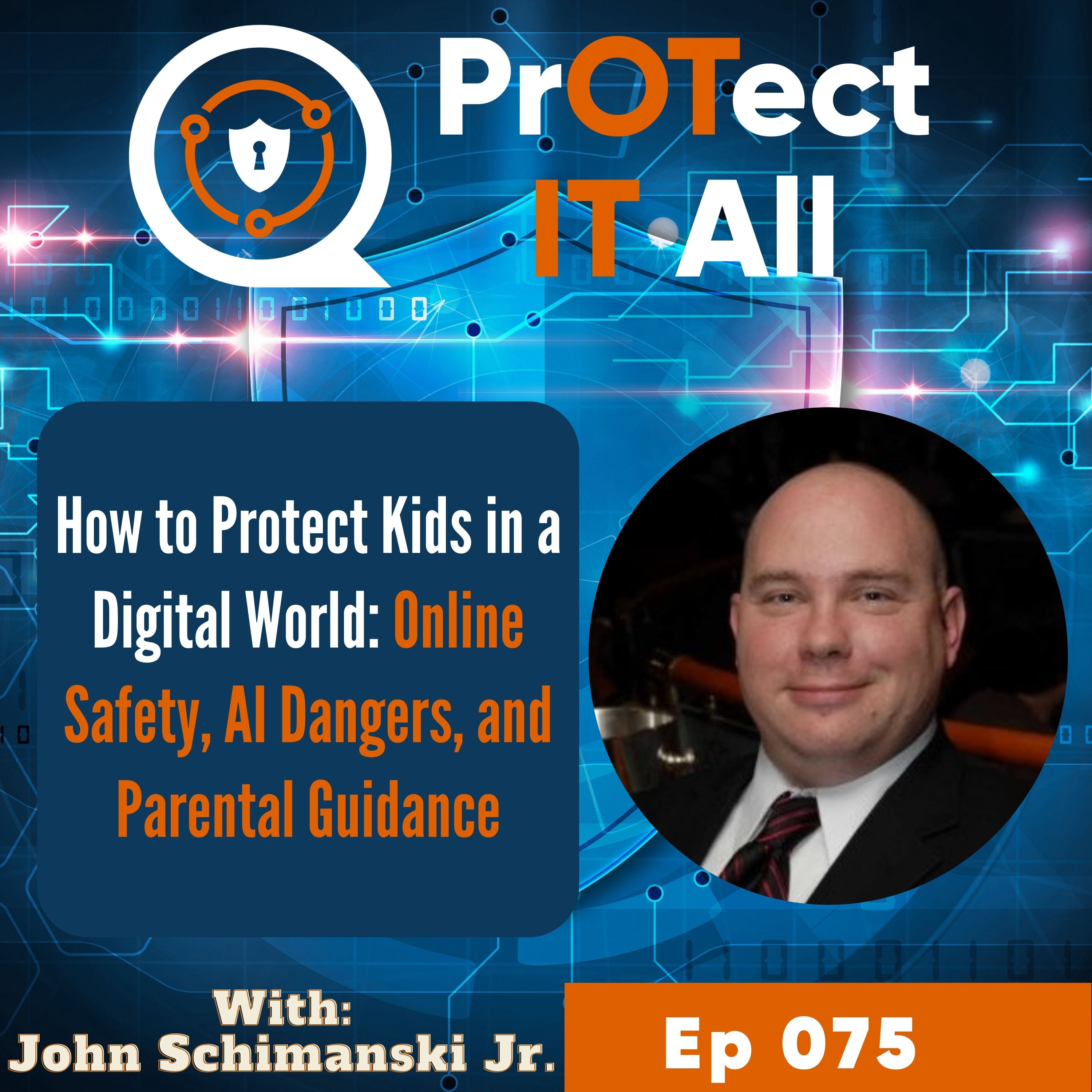
Episode 75
Interview
In this episode, host Aaron Crow welcomes cybersecurity expert John Schimanski Jr., Chief Information Security Officer at Trivigil, for an eye-opening conversation that every parent, educator, and technologist needs to hear. Together, they delve into the escalating dangers children face online - from the alarming rise of cyber predators and social media manipulation, to the misuse of AI and increasingly sophisticated scams targeting families.
John shares powerful stories from his work with educational institutions and law enforcement, highlighting how digital threats are evolving far faster than most parents can keep up with. Aaron reflects on personal challenges as a parent navigating device safety and digital boundaries, and the two discuss practical strategies for protecting kids in today’s hyper-connected world.
This episode doesn’t just explore the risks - it offers hope and tangible action, including details about cybersecurity education initiatives like the MASK Next Gen Shield game, designed to give kids and parents the knowledge they need to stay safe online. Whether you’re a concerned parent, a teacher, or someone working in the cybersecurity field, this discussion is packed with real-world advice and resources you can use right now.
Tune in for a timely conversation on the front lines of digital safety—and learn why, when it comes to protecting our kids, awareness and action are more important than ever.
Key Moments:
05:00 Digital Image Blacklist Management
08:08 Parental Cybersecurity and Tech Awareness
10:06 Fake Arrest Warrant Scam Alert
13:27 AI Development Concerns and Future
21:13 Online Predator Alert & Teen Safety
25:33 Limits of Facebook Moderation
27:29 Managing Digital Challenges for Parents
30:46 Teen Sextortion Crisis Emerges
33:44 "Saving Kids Amidst Social Media"
42:23 Broken Graphics Card Issue Resolved
45:33 Internet Safety Tips for Parents
49:43 Pause Before Reacting
51:17 Future Concerns and Optimism
56:46 "Essential Curriculum for Schools"
About the guest :
John Schimanski Jr. brings more than three decades of experience in physical and cybersecurity, spanning private and public sectors. Beginning his career in 1994, he worked as a physical security specialist protecting super-regional shopping centers in high-crime areas, focusing on stolen vehicles and safety operations. During this time, he earned two master’s degrees—one in Criminal Justice and Security Administration and another in Managing Information Systems—along with a bachelor’s in Business Administration.
He transitioned into cybersecurity in 2007, when ransomware was still a $5,000 payment on a green dot credit card. While working in a small data center, he developed customized web services and interfaces for organizations such as the Las Vegas Motor Speedway and Electric Daisy Carnival (EDC).
After building deep experience in the private sector, John moved into public service with the Texas Comptroller of Public Accounts and later served as Deputy CISO for the Texas Department of Criminal Justice. These roles gave him extensive insight into securing critical state systems and navigating the complex challenges of public-sector cybersecurity.
Today, John serves at Trivigil, a cybersecurity firm focused on strengthening the cyber posture of K-12 schools and universities. His career reflects a unique blend of front-line physical security, technical expertise, and leadership across sectors—making him a trusted advisor and advocate for strong, resilient security practices.
Links to connect John :
LinkedIn : https://www.linkedin.com/in/johnschimanski/
Link to October Event - Mask Nectgen - https://s14tu.share-na2.hsforms.com/2K3tpMqlmQ8SR_cGWXsitSw
Connect With Aaron Crow:
Learn more about PrOTect IT All:
To be a guest or suggest a guest/episode, please email us at [email protected]
Please leave us a review on Apple/Spotify Podcasts:
Apple - https://podcasts.apple.com/us/podcast/protect-it-all/id1727211124
Spotify - https://open.spotify.com/show/1Vvi0euj3rE8xObK0yvYi4
Aaron Crow (0:1.368): Thank you for joining me on this episode of protected all podcast. I'm super excited to have my friend, John here with me. So John and I have known each other since I've moved to Austin very early on. went to a cyber event, and John was there and now he's come to all of our, of our Lone Star shootout events. And I always see him at, the ISSA events where he's the CISO of, and, John, why don't you introduce yourself first? Thank you for taking time. I know we've talked about this and.
Aaron Crow (0:29.814): Schedules just haven't aligned. So I'm glad we finally sat down and taken the time to record this. So introduce yourself, tell everybody who you are, what you do, all the good stuff.
John Schimanski (0:38.466): Yeah, thank you and appreciate it. I know we've talked about this for what almost a year now and I've watched some of your episodes. think they're great. Thank you for having me on again. My name is John Schmansky. I am the chief information security officer for a company called TriVigil based here in Austin. We are a educational slash boutique cybersecurity firm focusing on education, small media market builds enterprises, as well as the universities in K through 12.
John Schimanski (1:4.418): My background includes both physical security for 15 years as well as cyber security. Since 2007 when was ransomware was a green dot credit card for $5,000 rather than multi-billion dollars in Bitcoin. You know when they were when the FBI basically said pay them and make them go away was kind of the order of the day because they didn't have time to go chasing the one incident I was involved in was in Czechoslovakia.
John Schimanski (1:31.118): That was interesting. It was a small phishing attack ransomware of a small company and $5,000 on the green dot credit card My CEO at the time said go get him. I started laughing Because it you know trying to get across the the world in a reasonable amount of time that money was gone So I really focus on education in small and medium business where they don't understand how cyber security is is changed from it if we get hacked to when we get attacked
Aaron Crow (1:56.130): Yeah. Yep.
John Schimanski (1:57.878): We've seen current things such as the Salesforce attacks that is hitting big business, Cisco. In fact, Tenable just got hit, what, two weeks ago through their Salesforce and lost all their client data, client contact information, they didn't get any financial stuff, but that just leads to more and more attacks up to and including in the educational sector, which is very big usage of Salesforce. But really what you and I talked about talking about on this is how we deal with cybersecurity in our kids.
John Schimanski (2:27.412): And this is getting literally frightening. I know you've seen my presentation at some point and I'm giving another presentation on October 1st at the International Accelerator here in Austin. And it's more so we're starting to see the same type of activities that we saw in late 80s and early 90s than a small white van. It's a free puppy, free candy to entice children.
John Schimanski (2:54.870): We're now starting to see those same type of predators, those same type of actors, as we open our children up to the internet, we've opened those predators up to our children as well. And I know you've seen this as well. And unfortunately, it's now starting to become almost a pandemic style problem, very much similar to what we've seen before. I've worked with the agency called National Center for Missing and Exploited Children. I've met those people that
John Schimanski (3:24.086): great organization. And for those of you who don't know, that was built in the early 80s with Ronald Reagan and a gentleman by the name of John Walsh who was America's Most Wanted host for a number of years. In fact, I think he's coming back. Yeah, I think he's coming back this next year or so with a new show similar to America's Most Wanted. But his son in early 80s was kidnapped and killed by a gentleman and he worked with the government at the time which was Ronald Reagan's presidency.
Aaron Crow (3:34.658): Yep. really?
John Schimanski (3:51.948): to build this legacy organization to help children. And one of the things that we've seen is most government agencies don't keep up with the times. That's not the case with the National Center. They've Congress to enact laws that state all social media must report what they call child sexual abuse material to the center. Last year was 20 million hits. Something like 65 instances a second or something.
Aaron Crow (4:20.974): That is terrifying.
John Schimanski (4:21.317): ridiculous. Well, you know, and it's a lot of they will say that that image is a lot of the same engine comes from discord. comes from Facebook. comes from social media sightings and games. And it's a lot of the same. But what they do is they take that image. Nobody has to see it. Nobody has to review it. They put it through a company. I don't remember who they turn around and digitally hash it and hand it back as a blacklist to the social media.
John Schimanski (4:49.217): The list is growing day by day and function by function. So one of my jobs and one of my opportunities is to work with not only big enterprise, but universities and K through 12 to help them decipher and get rid of this stuff on their own enterprises. We all know that there are bad apples in all kinds of employments. We've seen here in Austin, a couple months ago, there was a kindergarten teacher that was arrested for having
Aaron Crow (5:12.280): Yeah. Yep.
John Schimanski (5:18.293): pictures of CSAM on his personal device. As a CSO that frightens me as somebody who's worked with children most of my career and has two step sons of my own, that is frightening. What a lot of people don't realize, and I've seen this in both the cyber community as well as the outside community from an education perspective, they don't know. They think that these screens are now the new babysitter for their children. I've had personal friends.
Aaron Crow (5:30.903): Yeah.
John Schimanski (5:46.883): I will never give my kid a tablet, a phone. And four years later, kids four or five years old, and here they are sitting at dinner with a tablet in their hands. And we've seen these things, and we've seen these things turn to absolute nightmare situations. There was an article that came out about a week and a half ago, I believe it was the Atlantic. 21 % of children recognized and interviewed said they had nobody to talk to.
John Schimanski (6:16.524): but from artificial intelligence. That to me is just insane. I mean, we've seen what artificial intelligence can do. We're seeing it now. 41%, again, I believe it was either the Atlantic or Times, I don't remember which, came out about seven or eight weeks ago, said 41 % of the 1,000 students surveyed said they wish the internet didn't exist.
Aaron Crow (6:22.562): Yeah. Yeah.
John Schimanski (6:45.590): Now, you know, mean, it's those types of things, but we've opened up the internet to our children. Therefore, the internet is taking full advantage of it.
Aaron Crow (6:54.722): Yeah, yeah, know, it's insane. know, this started with me. I've got three kids. You know, my oldest is 16. We really noticed this in COVID times when they were all at home. you know, they had a lot, you know, obviously they had a lot more time online and they came home with devices. Like they had their Chromebooks and they had, you know, that's how they did school. And then we noticed it and I really...
Aaron Crow (7:22.976): It was innocent enough. I noticed my kids were tired every morning and I wasn't sure why we were putting them to bed. And then after we put them to bed, they were getting back up and playing online games all night long. There wasn't any real risk or anything other than, wow. I didn't realize that my kids were doing that. Right. So, you know, it wasn't a big risk other than I have, I'm a technologist, so you can't see it in the corner, but I've got a bunch of stuff. Like I've got wireless, you know, separate wifi for my kids and they have, you know,
Aaron Crow (7:49.785): They're restricted. can't go to websites. have applications on their devices so they can't go to certain websites and all that kind of stuff. So I was able to lock down their system so that the wifi turns off at 10 o'clock at night. you know, even now they have cell phones, but again, it's all locked down. Like they can't get to anything and I block it. And that's why I use Apple instead of Android. Nothing is foolproof, but I started doing all that, you know, all the way back in 2000. And it's amazing to me.
Aaron Crow (8:18.646): the amount of families and parents, and again, as a dad and uncle and all my friends' kids, how many parents obviously are not cybersecurity people and they don't have anything like that, right? They have no idea what apps are on their kids' phones. They have no idea what websites they're going to. They have no idea what games they're playing on their computers. We've all seen all of the struggles and difficulties with Roblox and all the child predators that are on that platform and what all is going on with all of that right now. So mean, it's just,
Aaron Crow (8:48.512): It's something that you have to be mindful of. And it can happen even if you, me and you and whomever, if we're intelligent about it, that doesn't mean that our kids, our wives, our families, our parents, our grandparents, like everybody is at risk. I told a story a while back real quick. I'll hit on it again. I think I may have told you, but Christmas of last year, I was in Dallas with my wife and my family and we dropped our kids off at my parents' house and we went to go grab a happy hour margarita and some queso.
Aaron Crow (9:18.550): And I got a phone call from the Williamson County Sheriff's Department or what I thought was a Williamson County Sheriff's Department. And it was a good old Texas boy accent. The phone number looked right, like all the things. And it was a scam. And they were trying to get me. They told me I had a warrant for my arrest and I had to go, go to the County courthouse and I had to give them money to make sure I didn't have. So all the things they were saying, nothing, nothing really set off my spotty sense until I pulled money out. And they said, okay, now, now that you've got money out,
Aaron Crow (9:48.611): go buy a gift card. And I'm like, whoa, no, I'm not doing that. Because before that, they had just told me to go to the courthouse and go to the sheriff. Like I'll go to the sheriff if I have a warrant, because they said I'd missed jury duty. And that because I'd missed jury duty, that I had to go, I had a warrant for my arrest and I didn't file the paperwork or if I did, they didn't get it, blah, blah, whatever. And I had missed jury duty, but I had filled out the form. But they had me.
John Schimanski (9:55.285): You know...
John Schimanski (10:3.307): Uh-huh.
Aaron Crow (10:16.747): All the way until and again the whole time my spotty senses were going off. I'm like, I'm not sure this is right. I'm not sure this is right. I'm not sure this is right, but you know if I'm going to Sheriff's Department, obviously there's no risk, but as soon as they said buy a gift card, I'm like yeah, I'm not doing that jerk.
John Schimanski (10:31.457): Well, you you touch on that. My mother's 83 years old, not technologically savvy. I have to fix her pretty much on a weekly basis or a monthly basis. we all think technology sons do. this is a story that goes back almost 10 years. She gets, I'm at work and she gets a phone call from somebody claiming to be my stepson, who's now in Vegas, who's in trouble with the police department.
Aaron Crow (10:44.537): Of course.
John Schimanski (10:59.293): And she calls me, this is two days before my wedding. And I'm sitting at the desk and she calls me and she goes, where's your stepson at my house sleeping on my couch for the next two days? She goes, are you sure he's not in Vegas? I'm like, he's, he was sleeping on my couch six, you know, three hours ago. I'm at work and back and forth. And my father was a police officer. She should have known better. But again, I need target gift cards to get myself out of jail. Like really, how does that work?
Aaron Crow (11:21.583): Mm-hmm.
John Schimanski (11:29.139): I will tell you, I don't know if you've been to Home Depot as of lately. Have you seen the signs behind the self-checkouts? They actually have. You cannot buy Home Depot gift cards to satisfy utilities, bail bondsman, bail amounts, jury duty, all of these, this list of things. I have a picture of it somewhere and they're the only
Aaron Crow (11:37.304): No.
Aaron Crow (11:51.023): Because enough people have done it, then they've complained to Home Depot that they put up signs.
John Schimanski (11:54.498): Correct. Yeah, my mother's been caught in the secret shopper scam for $2,000. Yeah, we'll talk about that one later because that'll curl your hair. think about what we were just talking about with the kids and the scams and the things that are going on, especially with artificial intelligence. The kids are seeing these things. The 14-year-old in Florida last year killed himself over a character.ai.
Aaron Crow (12:24.868): Yep.
John Schimanski (12:24.925): and the mother suing the company. The two cases coming out of Massachusetts and Texas for pretty much the same reason, but those were kids preparing to kill their parents because they took away their screen time at the insistence of the AI. Sam Altman and OpenAI got sued two weeks ago over a child committing suicide. These are things that we are going to continue to see until we step up, until we say enough is enough.
John Schimanski (12:55.271): And I will tell you not that I'm a big fan of the individual himself. I was very behind the idea of when Elon Musk about a year ago said, we need to stop AI development and start putting in guardrails. Now, let's be honest. We were going to be the only country that does that. Other countries weren't going to do it. And which is why it never really flew here because we realized mutually assured destruction. know, AIs would get bigger, better, faster, which they're doing now.
John Schimanski (13:23.089): Everybody's pouring millions of dollars and billions of dollars into AI technology and research. And it's only going to get better for humanity and worse for humanity. And by that, mean for our children. I'm a, I'm a, as you know, I'm an adjunct professor with Purdue University teaching cyber security and ethics, and I don't allow AI use in my classes. They can use it to the, what Purdue calls the first two levels of the AI allowance that we have.
John Schimanski (13:52.758): But I don't allow them to use it to quote it because we've seen that it's full of false information. It's full of hallucinations. It's full of things that we don't want out there in the public space. And I'm sure you see that in the O.T. space as well. know, what you know, I want AI to manage my cameras. That doesn't really work out well. I want them to manage my PLCs. Doesn't work out well. You know, I think AI is a great tool.
Aaron Crow (13:55.971): Mm-hmm. Mm-hmm.
John Schimanski (14:18.983): I use it on occasion when I'm writing things and something just doesn't look right to me or I need to verify some type of information that I know is true but I need the source material behind it and Googling just isn't getting it for me.
Aaron Crow (14:27.471): Mm-hmm.
Aaron Crow (14:33.327): Sure. Well, and it's one of those things where I mean, I use AI all day long every day, but to your point, I'm only using it for things that I already know, right? I'm not, I'm not asking it to like, I'll, I'll use perplexity for instance, instead of Google, like, Hey, what is a good restaurant that has, you know, Italian food in Georgetown, Texas, right? And I'll use it for that. Cause it kind of helps summarize things. It's, you know, it's not worried about the SEO as much things like that.
John Schimanski (14:41.078): Right.
Aaron Crow (15:3.203): But I'm not saying, hey, write this article for me, right? I'll give it a transcript. And it's funny you say the hallucinations. I've noticed different AIs are better at certain things than others. So like Claude, I can use Claude for some things and other things I can't. So I'll create a transcript from a podcast episode like what we're talking about today. And I'll take the transcript and I'll say, create a post for LinkedIn using the transcript of our conversation. So I'm giving it.
Aaron Crow (15:32.703): all of the context. I don't want you to make up anything. Everything comes from this. And I've built chat GPT and I've got a custom chat GPT trained well enough that it knows my podcast website. knows, you know, all my names, all that kind of stuff. So it knows the format that I want because I've given it all of that and it does a great job. But again, I'm giving it the answers. It's not having to go search for anything. It's not having to think about anything. It's really just formatting. It's really just call it, pulling out some nuggets.
Aaron Crow (16:1.135): based on a template that I gave it, it doesn't have to think in its collective knowledge to do that. But if I just said, hey, create a post for episode 75 of the Protect It All podcast, I've seen it where it just makes stuff up. And it's like, Aaron was talking to Elon Musk about AI data centers. No, I wasn't.
John Schimanski (16:23.905): Well, we did an experiment, some friends of mine, about a year ago. This back when, you know, I it was like Chad Chibit two or three or something. And we just said, what do you know about this person who happens to be in the dog show world or was at the time? The first 50 % of it was a hundred percent correct. It was a hundred percent spot on. This was his profession. He's well known. This is his breed, whatever.
John Schimanski (16:50.901): Then after the end of it, or towards the end of it, it started coming with, as what you'd say, absolutely made up stuff that would not fly in the real world. It told it, it said that he won the Westminster Kennel Club Dog Show, which we both have actually been to. Neither one of us are getting towards that trophy. That's just not gonna happen. Our breed is not well known enough. And then it said it won the World Dog Show. No, that didn't happen.
John Schimanski (17:17.717): You know, so, and I believe it was Altman that came out like 90 days ago or within 90 days ago that says that they have to reset the code for chat GBT, which is why we're seeing new iterations of chat GBT because the hallucinations are getting so bad. Like that, that frightens me because there are people on the internet and it's now become almost an American psychology index called AI psychosis.
John Schimanski (17:47.395): And we're starting to see that not only encroach on what is the AI telling us? Is it true or not? Is these things thing? But we're starting to see it in interpersonal relationships between humans and AI. An article came out three, four weeks ago about a gentleman from New Jersey thought this girl was in New York, was in love with him. He was already in diminished capacity state when he 75 years old.
John Schimanski (18:14.868): ends up trying to go to New York from New Jersey, slips, falls, kills himself at the train station. Now, I believe it's Facebook and Metta that's being sued over that one. They've come out and said that the AI models, doesn't matter who it is, are now allowed to sexualize things, not just for adults, not just for the entertainment value or the pornography or anything like that, but even for children. mean, Metta's 235 page that was just released within the last six weeks.
John Schimanski (18:43.680): shows is allowed to have sexualized conversations with children, which is frightening in and of itself. So we have to not only protect and put in these rails, but we as parents, we as adult educators, we as cyber experts need to be sounding this alarm saying, we're not going to tolerate this anymore. And one of the things that I present in my presentation is
John Schimanski (19:13.698): We've gone away from what would normally traditionally be the nuclear family. Mom and dad, two and half kids, the dog, the white picket fence. In preparedness for this presentation that I did back in May, YouTube is I think 22 years old this year. When I grew up on the internet, you grew up on the internet, we had CopyServe, AOL, Netscape, all the platforms.
Aaron Crow (19:18.201): Mm-hmm.
John Schimanski (19:38.061): There was PSEs almost on the nightly news. Don't talk to strangers. Don't give out your information. Don't do this.
Aaron Crow (19:43.065): Do you know where your kids are?
John Schimanski (19:45.571): Oddly enough, my presentation is called, it's 2025, you know where your kids are surfing. You know, but there was PSAs almost on the nightly news on how to deal with this new world order of electronic communication. You know, the screeching of the modems and everything else aside, I could not find one on the internet. I could not find a PSA on YouTube from since the beginning. And we've really stopped.
John Schimanski (20:15.628): We've stopped teaching this and one of the things that I'm very proud to work on is a program called Mask. And the company is called Mask Next Gen Shield, I believe. And it's a cyber security game to help kids understand that not everybody on the internet is your friend. Not everybody you play with on Fortnite, not everybody you play with on Roadblocks or Minecraft or any of the other social media platforms.
John Schimanski (20:45.836): They're not your friends. You might know them tangentially. You might not know them at all. And this might be people that you are now emboldened to try to get, you know, there's predators out there acting as 10 year olds, 13 year olds on these platforms that are going to try and manipulate you or in the common vernacular groom you to go to discord, gilded, some type of other platform to get away from the sensors, to get away from.
Aaron Crow (20:47.407): Mm-hmm.
John Schimanski (21:14.370): prying eyes of other people in order to start looking at it. There was a lady who posted on Instagram about a month ago that lives in Peoria, Arizona. Her 15 year old daughter stole her cell phone and her credit card and was headed to the port of entry in Mexico from Arizona. She had about a three hour timely, three hour gap between she knew where her daughter was, it wasn't.
John Schimanski (21:44.791): Border Patrol with the help of the Arizona law enforcement authorities, the National Center for Missing and Exploited Children, caught her as she was going through the border, the of entry into Mexico. There was somebody waiting for her on the other side. Like, I can't imagine what she went through for those three and a half hours, three hours. And she willingly posted it on Instagram. And I have a copy of the video that said, artificial intelligence helped these people take my daughter.
John Schimanski (22:15.394): because they were using it as a catfishing scan. And we've seen it before. It's not only coming out of Mexico, it's coming out of Nigeria, it's coming out of even here in Texas. And one of the groups I found, it's a group called 764, which is the first three numbers of the zip code for Stephenville, Texas. This group was created by a gentleman by name of Brandon Cannonhead.
John Schimanski (22:45.652): and is considered one of the most vicious, violent online groups to this day. FBI came out about six months ago, said every one of their 55 offices worldwide has at least one open case on this group. So I did a little digging as you know, I am prone to do and I went down this rabbit hole and I found out through public information and information available on the internet.
Aaron Crow (23:0.804): Wow.
Aaron Crow (23:4.014): Mm-hmm.
John Schimanski (23:13.890): Brandon Cannonhead was 15 when he started this program. At 17, he was tried as an adult and sentenced to 80 years in a Texas prison. That's not something I want to do. Having worked for Texas Department of Criminal Justice at one point in my career, not something I want to do. You I don't want to serve. I would much rather stay on this side of the bars. But for the FBI to come out and say this is the most vicious
Aaron Crow (23:26.244): Mm-mm.
Aaron Crow (23:32.611): Mm-hmm.
Aaron Crow (23:35.949): Yeah, no kidding.
John Schimanski (23:42.915): vicious violent group on the planet and then every one of their 55 field offices has at least one case. I think the article said they 254 cases on this group is disturbing and this was created by a 15 year old.
Aaron Crow (24:0.431): Wow.
John Schimanski (24:1.538): I'm like, I don't know where you come up with that. I don't know how you become that. They had a nine year old killer hamster on live video, self cutting routines. I mean, we all know the psychology of this. You know, you and I both do the psychology of black cats. I mean, where does this stop? Where do we step in and say enough is enough? And the time is coming. This is becoming a pandemic, a sizable.
Aaron Crow (24:11.663): Mm.
John Schimanski (24:31.074): portions.
Aaron Crow (24:32.139): It is, and I think part of the problem has become, from my perspective, parents have always, we've always put, not just parents, but people in general, we expect organizations, governments, et cetera, to protect and help, right? So, you know, the police department stops the people down the street from, you know, robbing your house, or if they do, they respond and they react.
John Schimanski (24:37.644): Sure.
Aaron Crow (24:57.859): but we've both seen this, you call your local police department, they have no jurisdiction for somebody that just hacked you, none whatsoever. Then you call the FBI, you, what if it came from Russia? What if it came from, you know, they're hopping their packets all around the world. So it doesn't work that way, right? You can't depend on Facebook to do it because not that they're not trying to do it, maybe they are, maybe they aren't, but how could they possibly stop everything when you're talking about millions and millions of users and hundreds of
Aaron Crow (25:27.405): billions, trillions of communications that are going back forth and things that are being shared and everything like, you know, it gets beyond, it gets to be an exponential problem. So it's just like my views on government. There's things that the federal government needs to do. There's things that the state government needs to do. And there's things that the local government need to do. And then there's things that you need to do in your own house. Like I don't leave my front door unlocked.
John Schimanski (25:53.120): You
Aaron Crow (25:53.207): Like, you know, and I live in a really safe area. Like I live in a great neighborhood and a great city and there's not a lot of crime here. And, sometimes my door is left open, but I don't make that a habit. I leave my door locked when I leave. I lock it when I'm here. Like I have firearms and things like that, that I'm, that I protect myself with. But, but the point is, is that we have to take control of my household. Like you need to be responsible. You parents, uncles, aunts, you know, you have to take control of your own.
Aaron Crow (26:21.727): safety and your kids safety, nobody's going to do it for you. Nobody's going to rescue you, right? So, you know, there's, I believe there's a huge gap in the, in the, in the commercial world. you know, even when I'm, building out like my home network, I'm, I'm a nerd, I'm a cyber geek and I've been a network admin and all the things. So I can,
Aaron Crow (26:43.235): Grab all the tools that I can buy enterprise level, you know, PFSENSE and firewalls and, I know how proxies work and I can put up a pie hole so I can secure DNS and, there's all these things that I can do. You're every, I'm looking out my window. Every one of my neighbors probably don't have that capability, right? So there there's no tools available for parents to do this stuff that aren't a cyber person, right?
John Schimanski (26:59.938): No, and we need to educate.
John Schimanski (27:7.830): Well, there was, I mean, at one point Disney had one, the Disney ring. And that's gone by the wayside because, you know, parents were tired of hearing, you know, Johnny and Jane say, I want to go do this or I need to do this for school. And then they need to spend 25 minutes trying to figure out how to do exactly that. You know, you mentioned PSN, you mentioned pie hole, you mentioned these things that you and I understand just by Peter saying the words.
John Schimanski (27:33.504): I mentioned Piehole to a friend of mine last the other night while I was talking to him because he's got a 15 year old kid that's kind of running amok on the internet and he's like what is that? I'm like dude I'll build you one I will send it to you with written instructions on how to do it and I will manage it from here.
Aaron Crow (27:49.871): It's a Raspberry Pi. I can set up a Raspberry Pi. It costs me 50 bucks to send it to you. It's not a big deal.
John Schimanski (27:54.950): Well, because he doesn't know that's not what he does and It's great, you know open DNS duck duck go, know Google DNS and all of these DNS factors are thinking they're not understanding there's no way to register the fact that you have a 16 year old plus children under the age of 16 I have my two step-sons are in their 20s I hate to think what they got into on the internet before they met me, but you know
John Schimanski (28:22.486): We're sitting here and we're not gonna legislate our way out of this problem. It's not gonna happen. There was a Republican Senator here in Texas, it was House Bill 2610, in this last legislative session, that wanted to restrict social media to everybody over the age of 18. That's not the answer. Part of the reason I ran down this rabbit hole is I have a very good friend of mine. Her son was 16 at the time. She gave him access to social media, Instagram, Facebook.
John Schimanski (28:52.450): We won't even get into the Snapchat problem. I personally don't care for that app at all. Most people don't actually understand the origins of that app. But within six months, he was a victim of sex-sortion. 17-year-old girl, wasn't a 17-year-old girl, let's be honest. Wanted $400 to not send pictures. We can imagine what kind of pictures that was. Not safe for work comes to mind.
Aaron Crow (29:2.735): Mm-hmm.
Aaron Crow (29:12.239): Mm-hmm.
Aaron Crow (29:19.191): Mm-hmm.
John Schimanski (29:22.210): to not send them to his friends, family, co-workers, his manager, his parents, who happens to be a good friend of mine for 32 years. he had the money the first time. So they came back again for the second round, wanted $400 more that he didn't have. He ended up attempting to kill himself. Fortunately, he was not successful, kind of mentally repaired himself, of mentally got himself out of this hole.
John Schimanski (29:50.913): She didn't know about it for almost three years. And she called me one day and said, hey, I need you to verify these people work for this agency, anything you can do. And I said, send me the info. She sent me a picture of a department of Homeland Security officer and a Secret Service agent. Now I want to know the story. She's like, I can't tell you this story because they're sitting in my living room right now. They actually physically got the information from a bus that they did.
Aaron Crow (29:54.223): Wow.
John Schimanski (30:19.234): from a chat server that they got and we're wanting to talk to him and her about it. Now he's 22, he's a good kid and he's mentally, I'd say, more aware. But how many of these kids you know of that aren't mentally aware that would do something like this? now it's starting to happen. I know of at least 50 cases last year that they attributed teen suicide to these sextortion rackets.
Aaron Crow (30:26.735): Mm-hmm.
John Schimanski (30:47.774): all coming out of a group out of South Africa. We've all seen the Nigerian Prince scam and now it's becoming more and more prevalent for children to be targeted. And we were talking about this probably about six months ago, me and my friend, we all did dumb things when we were kids. I know I did. My father was in law enforcement. I did things that probably weren't exactly 100 % kosher.
Aaron Crow (30:54.328): Yeah
Aaron Crow (31:8.023): Mm-hmm.
John Schimanski (31:17.126): But there was no video. Huh? You were saying? Uh-huh. But, you know, we didn't have cell phones to record this. We weren't doing these things for notoriety. We weren't doing these things for the latest TikTok trend. The duck lips challenge comes to mind. Which is kind of just stupid, but whatever.
Aaron Crow (31:17.642): Not me, I was a saint. I said, not me, I was a saint.
Aaron Crow (31:27.801): Correct.
John Schimanski (31:40.131): Nowadays they're doing these things for life. They're doing these to keep up with the Joneses. They're doing these things to get millions of views and become somewhat of an internet celebrity even though it may not be legal. Or now they're being attacked by these people who are obviously not legal. And these things, but they don't understand how to deal with these issues. And one of the things that I caution parents with, if your kid comes to you and says, I've done something stupid.
Aaron Crow (31:56.783): Mm-hmm.
John Schimanski (32:9.130): I've done something bad. I've done something wrong on the internet. The most key piece of advice I can give to those parents, don't criticize, don't punish. Figure out how to solve the problem for your child without making them feel like they're a victim. Because they are a victim. We've seen this. But if they can't come to the mom, they can't come to the dad, they can't come to the teacher, they can't come to the adult.
Aaron Crow (32:19.897): Yep. Yep.
John Schimanski (32:38.452): in their lives to say, I screwed up and I need help. They won't come to you when it's important. And I've seen this time and time again. see this online. I'm a member of several parenting groups on Facebook and other social media platforms where I've seen both ends of this. My kid came to me. I took his screen away. My kid came to me and I helped him and I supported him. And you know,
John Schimanski (33:7.542): The FBI will tell you file a complaint with the IC3. I filed several complaints, never hear anything back. You know, the police department, there's not much they can do about it. They're gonna take a report. They're gonna forward it up to the FBI. It's gonna go nowhere because there's thousands, as you said, there's millions and millions of these conversations happening all day long on social media and we're not getting it. We're not getting it there. Now, if...
John Schimanski (33:37.591): And I said this in my presentation, and if my presentation gets through one set of parents, one parent, and saves one kid's life, my work is done. That is more important to me than, you know, financial, anything I get financially out of this program or out of this work is if I can stop one kid from falling victim to this, that's a game changer for me. That's a win. Because...
Aaron Crow (33:47.246): Mm-hmm.
Aaron Crow (34:3.139): Yeah. Yeah.
John Schimanski (34:4.930): And we've done this with several schools now and the program is going to launch in believe January with this game to the schools. We're going after the kids at school with a school component and other things. But if I can save one kid, know, part of the reason I'm sure why you do Protect It All is you can save one person, one system, one thing. It's worth the effort, the energy and the time.
Aaron Crow (34:14.521): Mm-hmm.
Aaron Crow (34:25.401): Mm-hmm. Yep.
Aaron Crow (34:32.015): 100 %
John Schimanski (34:33.026): And that's why I'm a big pro advocate of this is one, it's hit me personally with a friend of mine I've had for 32 years. I know that some of my cousins, my cousin kids, my nieces and nephews, they've been victims. We just don't know it.
Aaron Crow (34:45.869): Yeah. Yeah. Well, and it's, one of those things where, again, you hit on it a second ago, back in our time, back in my day, you know, we, we only dealt with bullies that were next to us, right? I could stand up to that bully or not, but I wasn't dealing with bullies in China. I wasn't dealing with bullies in schools. mean, I did, my wife and I just watched the documentary. I don't remember what it's called. Everybody probably knows what I'm talking about where the, the, the girl was getting cyber bullied.
Aaron Crow (35:15.671): And it was her mom the whole freaking time doing it. And she was just for two years, she was cyber bullying, saying the most including, why don't you go kill yourself to your own daughter? Right. It just. Holy cow.
John Schimanski (35:19.244): for two years.
John Schimanski (35:28.652): Right. Yeah. I just watched that the other day as myself, as a matter of fact, it's called unknown number, high school catfish story. But again, we were talking about this the other night. People will say things on the internet using the anatomy of the internet that they would have gotten punched in the face for standing in front of people. It's kind of like that meme. You say things that you would get punched for in person.
Aaron Crow (35:38.133): It's insane.
Aaron Crow (35:51.715): Yup. Yup.
John Schimanski (35:58.387): on the internet that you would never say in public. We've seen it time and time again, an anonymous tip, an anonymous saying, you know, and you're right, this was the girl's own mother over two years, destroyed her romantic sweetheart relationship she had with that kid. Her friends were getting interrogated by the police department and the FBI. How traumatizing is that?
John Schimanski (36:26.298): And even she said, I don't know what happened. This turned into and it snowballed itself, but it's the power of an enemy. You know, you and I go out for drinks. We meet with cyber professionals in this city, in this state. have good times at the Lone Star Shootout. We know these people professionally and personally where they would, these are true professionals, but you get to the level of an adolescent mind.
John Schimanski (36:56.372): and I can say this and be anonymous about this because I don't like this person. You know, and you're exactly right. In my day, there were fist fights on the quad. I went to a prestigious All Guys Catholic High School in California, where the parents were paying big money a month to send your kids there, and we still had fights on the quad. Now it's...
Aaron Crow (37:8.505): Mm-hmm.
Aaron Crow (37:20.271): Of
John Schimanski (37:22.358): You know, I don't like this person. I'm going be nice to their face, but I'm going to trash them online and they don't understand the consequences of their actions. And you know, we place such a value on human interaction that we should be encouraging our kids go out and play soccer. out and find your tribe. I do this all the time with my cyber students at the college. I always get asked, how did you get here?
John Schimanski (37:50.689): How did you get to be a Purdue instructor? How did you get to be a CSO? How did you get to the knowledge? It's not because I've got dual masters. It absolutely is not. It's because I have found a tribe in you and Aaron and the guys we deal with all day long, every day, the ISSA chapters, the meetups, the networking events, the happy hours to find these people who can support what I want to do, what you do, because I don't know everything. I don't pretend to know everything.
Aaron Crow (38:19.983): Of
John Schimanski (38:21.434): I know people and I can put a call out. tell this to university all the time. I don't know everything. I don't even pretend to know anything anymore. But two things. One, if you give me enough information, I'll make a decision. We will go with the direction, whether it's right, wrong or different, but it's going to be the correct direction for your organization. And two,
Aaron Crow (38:41.935): Mm-hmm.
John Schimanski (38:44.194): If I don't know, I'm going to put it out to my tribe and my people to say, who knows about this and who can tell me about that? Because this, and you've heard me say this, cybersecurity is a team sport. Whether you're a parent, whether you're an educator, whether you're a professional or the guy we just sat in a seat for a cyber analyst, this is a team sport and we need to talk to each other because the black cats are.
Aaron Crow (39:8.259): Yeah. Yeah, absolutely. Yeah. And comes down to, you know, not knowing or being ignorant is not, it's not an excuse anymore. That's another reason why I do this podcast, right? It's funny, like the first time, so I've been doing this podcast for going on four years, I guess now, the first one I had to rebrand it. so this one I've been doing about two years.
Aaron Crow (39:34.639): you know, a little over 70 episodes, 70, almost 80 episodes, average around one a week. And when my mother-in-law who has nothing, she's not technical, she's not cyber. When she came home, she came over one day and she was like, oh, I listened to your podcast the other day. And I was, I was like, what, why? She's like, I don't know. It's interesting to me. And I felt like she told me which episode again, I don't remember which one it was, but she listens to my podcast and she thinks it's interesting. Like,
John Schimanski (39:39.104): Right.
John Schimanski (39:52.008): Yeah.
Aaron Crow (40:2.699): Everybody should be and it doesn't mean you need to listen to my podcast or whatever, but there's enough people out there that are doing good things that are having conversations that have podcasts that have YouTube channels. Like there's all this stuff that people are doing because they care because because they, for instance, prime example, the other day my son, my oldest is on, he does have social. He's the only one that has social media account, but it's protected underneath me and I monitor it, all that kind of stuff.
Aaron Crow (40:29.555): and it's a kid's account, which that's one good thing. think Facebook has done is they have them, you know, kids accounts and the parents are custodians of them. And so we can see the messages, all that kind of stuff. Right. you know, obviously that doesn't stop them from creating his own account, but that's a whole nother conversation. have other ways to protect that, but, he, he entered a, a giveaway, this, this, this influencer, video guy that, that does, what does he do?
Aaron Crow (40:57.391): It's like, uh, he builds gaming PCs and talks about the latest hardware and things like that. He won a giveaway. So he sends me a message. Hey, I won this giveaway. And I was just like, okay. So he goes, he says that I'm not 18. So I have to let my parents know. And that I, that he'll send me, it's a $3,000 gaming PC. I'm like, all right, send me his information and I'll reach out. So I sent him his info. He sent me the information. I reached out to the guy, guy responded. Okay. This is.
John Schimanski (41:3.064): Sure.
Aaron Crow (41:26.967): So I checked out his page, obviously first and the guys in Houston and seems to be, you know, on the up and up. It doesn't look to be a scam, all the things. So he's like, Hey, your son won this thing. You know, it was, it was a giveaway sponsored by ASUS and you know, I did a review on it and now we give it away to our, to our audience. Every time we build one of these PCs, we give them away. Okay. He goes, all I need is your name, your address and your phone number. I'm like, okay. So I gave him my name. I gave him my.
Aaron Crow (41:56.725): UPS mailing address and I gave him my Google voice phone number and I said, send it on and then it shows up and sure enough it was, it was real, right? I, I logged it in, I scanned it before I put it on my network, like all the normal, you know, but the, the, the graphics card was broken and I'm like, Hmm.
Aaron Crow (42:21.327): So I, I, I pulled it off and the graphics card had broken the little tab so it wouldn't plug in the motherboard. and so I reached back out to him I'm like, well, I'm like, Charlie, he may not fix it. don't know. So, but no, he was super apologetic. He ordered another motherboard, sent it to the house. And he, this time, since I'd already talked to him and started going back and forth, the guy's a vet. He w he was in the army, super nice guy in Houston. And he goes, me to send it to the same place? I'm like, well, now that I know you're not a scammer.
Aaron Crow (42:50.285): Here's my actual address. You could send it to me instead of the UPS store.
John Schimanski (42:53.522): Yeah, but I mean, it behooves us as parents and as adults. And I'll be honest with you, basic human beings to take that one step further to protect our children. My two step-sons, I care for them both and one of them's gonna be working with me on some other projects and some other things. The other one's going to A graduating next year with dual.
Aaron Crow (43:5.252): Yes.
John Schimanski (43:22.604): dual degrees. mean, you know, and they call me and say, Hey, what is the problem with this or how can I protect myself from that? And as a parent and somebody who cares about children and particularly these two, we have to say yes and no. We have to say this is what the problems are. You're an adult now because they're both in their mid twenties, make your own decisions. But I will be here to support you when you run into a jam. And I think we're seeing, we're starting to see that shift. But again,
Aaron Crow (43:41.443): Yeah. Yeah.
John Schimanski (43:52.311): The government's not gonna legislate this problem. We as parents, we as adults, and we as professionals need to do that for them. As you said, protect our own homes. I don't leave home without several things. I don't expect anybody else to. I do follow the law and I'm certified in certain things and if a place has a certain sign, I won't walk into it with those things. But again, it behaves...
Aaron Crow (44:2.031): Correct. Well, and, and, yeah, it's.
John Schimanski (44:21.074): It behooves us to be, I don't want to say paranoid, but prepared.
Aaron Crow (44:25.027): Yeah, well, and it's no different than as a parent. have to talk to my kids about the birds and the bees. I have to talk to them about, you know, not I've talked to my daughter about not going down a dark alley by herself and in the city. Like there's just certain things that we have to prepare our kids. And this is one of those things. And the problem is, is that most parents aren't, aren't prepared to have that talk with their kids because they don't know it themselves. Like they don't have the literacy in cyber to be able to have it. So
John Schimanski (44:30.517): I agree.
John Schimanski (44:50.818): and they don't understand it.
Aaron Crow (44:54.561): reach out to somebody like me or like John, I'd be happy to talk to your kids about it. I'd be happy. I've done these talks. I'm, I've done a talk with there's an organization. I can't remember the name of it right now. I'm sorry about that. but it's a, it's a woman's organization and I was on a call and it was a woman's mastermind. And I think there were like 60 or 70 women on the call.
Aaron Crow (45:18.383): and they were all moms and aunts and sisters and they had kids or nieces and nephews and all the things. And I just did 30 minutes of all the risks on the internet and how they can protect themselves and just basic stuff. Nothing super technical, you know, the pie hole and you know, adding monitoring and why I use an iPhone over an Android. I'm not saying iPhone is better than Android. I'm just saying as a parent, I can control what they install on this phone a heck of a lot easier than I can on an Android.
Aaron Crow (45:47.471): You know, I know every app that my kids put on their phone, I have to approve, right? Little things like that make it, right? So those conversations, again, find somebody that's willing to help you have those conversations and we'll do it. Like I would absolutely talk to anybody. Right now I'm saying this publicly. If you need me to have a conversation with your family, your parents, your grandkids, whatever, I'm happy to do it, right? 100%, no charge, not looking for anything in return.
John Schimanski (46:10.358): Yeah, it does.
Aaron Crow (46:13.679): I as a dad, as a man growing up in the South and the way I was raised, I always want to give back and help.
John Schimanski (46:20.962): Well, and you know, I was on a podcast yesterday, don't remember the name of it, you know, and one of the biggest pieces of advice I can give anybody in the cyber world, anybody who deals with anything, whether it's you work with email, whether you get text messages all day long, whether you get phone calls all day long, anything, the biggest thing that they want to do, the scammers want to do is create that sense of urgency. And I've been the recipient of this, take a second and breathe. Take a second and think.
John Schimanski (46:49.750): A good friend of mine when I was training to be a police officer that I never got there, but he was a training officer for a police department that I worked with. He said when he gets those big calls, the armed robberies, the shootings, he takes 10 seconds and just frees three breasts long and deep and try to get that adrenaline out of the system. Try to make sure that their brain is focused on now getting there instead of the emotion and instead of the
John Schimanski (47:16.236): the adrenaline pumping behind there. goes, that's the best advice I can give you trying to get into this structure. Think about, think and breathe. And I got, I was the victim of one of these, Hey, your credit card's been hacked. I need you to log in and do this. And I, I, I, the story goes, I was doing my bills that morning. I was at a store when this happened. Hey, your credit card is now being hacked at some store. Wasn't the store I happened to be in, but it was some store.
Aaron Crow (47:40.835): Mm-hmm.
John Schimanski (47:44.117): and I clicked on the link from my phone, it brought me to my credit card login page on the web browser, and I stopped. And I thought about it for a second. Wait a minute, I was in my bank account earlier this morning. This looks legit, but let me look at the header that's coming across. Let me look at that bar and sure enough, it was not my bank. Looks good, looked great.
John Schimanski (48:9.686): Had I not taken that pause to think about what I was doing in those ramifications, I could have been easily the victim of identity theft. Or my bank accounts could have been drained. Yeah. One second.
Aaron Crow (48:19.935): Yeah, and all it takes is one click.
Aaron Crow (48:24.911): And again, if they can get you, if they could, and they're so sophisticated now that it's not, nobody is out of the way of being able to be hit. They've gotten so good. AI is going to help them get better and more efficient at it. That the emails look better. It's harder to detect phishing attempts now. Like you've got to really be very careful.
John Schimanski (48:46.038): Did you? Did you?
Aaron Crow (48:50.575): Cause at any time that can be, that's why, for instance, that's why I'll use a, you know, like a password vault. So if I do click a link, I don't ever enter my password in everything. My, my password vault does. So I can't tell the difference between an A and a Cyrillic A, right? But it can. So when I do, when I enter the password, it doesn't recognize that I have an account there. I'm like, wait, that's weird. Why is that? Why does it not know that I have an account here? And then I start thinking about it like, wait, this isn't
John Schimanski (48:56.226): Thank
Aaron Crow (49:18.477): That's not an A. That's an acrylic Russian letter that is not A.
John Schimanski (49:23.788): Well, I mean, but again, we're professionals. We do this for a living and still can find ourselves in those types of positions. Can you imagine the average person who is not technically savvy? You know, these are things that we've gotten away from teaching others to learn, to understand, to take that second. There is no thing in this world right now.
John Schimanski (49:51.030): that requires an immediate action when it comes across as a text, when it comes across as an email, or even a phone call. I have told personal friends of mine, I can't deal with this right now. Give me three or four minutes and I will call you back and then we will discuss it. Don't do anything until I have time to think about this as a professional. Because at some point we're gonna become victims too. It's not a when problem, it's not an if problem, it's now a when problem.
John Schimanski (50:22.035): And let's be honest, don't trust a criminal.
Aaron Crow (50:27.340): Believe it or not, they're breaking the law already. So why would you trust them that they're going to stop breaking the law after you do what they tell you to do? Yeah.
John Schimanski (50:34.058): And we've seen this. Power Schools is a prime example of that. They got 72 million records stolen. They paid the ransom. They have a video of the quote unquote hackers deleting data. And now we're seeing K through 12 being blackmailed with the same data that was stolen. Did you really expect them to honor their word? So.
Aaron Crow (50:56.739): Nope. Obviously they did cause they paid. They just kind of, hoped. So, so John, talked about a lot. There's, there's a lot of, man, there's a lot of things in this nugget. I think we could probably talk for three hours on this topic. It's near and dear to my heart for sure. But you know, knowing what we've talked about, knowing what you've seen, what we've, what we both experienced and kind of the horizon.
John Schimanski (51:13.602): Enjoy.
Aaron Crow (51:24.183): Next five to 10 years, what's something that you see that's concerning, getting worse, getting beyond what we've we've already talked about. And maybe what's one thing that's good, exciting, awesome that you see coming over the horizon that could be a benefit to this or other topics.
John Schimanski (51:42.024): So it's gonna be the same answer for both. Something that I find both very frightening and both very good. And that's artificial intelligence. We used to say that the lack of information caused people to be stupid and we've proven with the internet that's not true or the lack of common sense. Artificial intelligence is going to be both the greatest tool that mankind has ever created and it's also gonna be the worst tool.
John Schimanski (52:7.593): And if you saw the article with James Cameron, he started laughing and said, I warned you in 1984. You know, but we need to understand the limitations of our own inventions. And yes, it's great. We're starting to see cybersecurity use AI more for getting rid of or being able to produce these millions of lines of code and produce these millions of lines of, and get rid of the alert fatigue that we're starting to see. Hey, this doesn't look right.
Aaron Crow (52:12.639): I saw that.
John Schimanski (52:36.339): out of five billion lines of logs, this doesn't look right, go look at this Mr. Analyst. But the problem becomes is we're gonna start relying on it more and more. And it's getting faster, it's getting better, quantum computing's coming. I'd say in the next five years we're gonna see quantum computing at the dead stop, because it's getting more more prevalent. But we need to understand, get out of your house,
Aaron Crow (52:42.191): Correct.
Aaron Crow (52:50.159): Mm-hmm.
Aaron Crow (52:57.859): Yep. Yep.
John Schimanski (53:4.255): Get off your computer, get off your phone, start having human interactions versus just interacting with an artificial intelligence. just saw an ad today. You can hire 70 AI workers to do what you need to do and create your own company out of one person. Really? Does that do anybody any good? No. Is it great for efficiency? Yes. Is it great to have a tool that can search the internet?
John Schimanski (53:31.593): and find what you need to find without the hallucinations? Yes. But we need to understand that there are both humans that need to be interacted with and that there's human ingenuity that needs to be protected. Artificial intelligence, I look at it as two sides of the same coin. It's the devil on your shoulder, it's the angel on your shoulder, but we need to understand that it has both good qualities as well as drawbacks.
Aaron Crow (53:43.555): Mm-hmm.
Aaron Crow (53:56.867): Yeah, a hundred percent for sure. All right, John. So how do people find out more about the game, about the things you've got going and any, call to action for folks, to reach out, et cetera.
John Schimanski (54:9.355): So the call to action is pay attention to what your kids are doing online. Have those conversations, make sure that your children and your friends children, your nieces, your nephews all have a safe space to at least come to you. Find a cyber professional within your realm of people to come to and ask questions. You can find me on trivigil.com, T-R-I-V-I-G-I-L.com. You can find me on LinkedIn under my own name, John Schmansky Jr. You can find the game at masknextgen.com.
John Schimanski (54:39.353): We're currently rebranding it. For those school officials that listen to podcast, we are doing betas right now in schools that seem to be going off very well. There will be a school component. There will be artificial intelligence component built in. It gets better. It gets harder if you're good at it. It gets easier if you're not. So we don't want to discourage kids. But, and it's going to be reasonably priced for school districts and parents. Parents want to buy it outside of school districts that don't have it. We will have a component for that.
John Schimanski (55:8.505): I can talk about this topic all day long. I'm very proud to be involved in this project to bring it out. We are, for those of your podcast listeners, having a meetup on October 1st at the International Accelerator in Austin. It'll be, I believe it's on the website. I will give it to you, Aaron, so you can put the poster up in the, so we can find it. You can register for it.
John Schimanski (55:33.356): We're doing this as kind of a parent and teacher night where we're have the explanation of what the threats are, what we're doing with the game and how the game can benefit you and your child. So the call to action, come find me on the internet. I'm not that hard to find. I'm in Austin, I'm at the meetups, I'm at the ISAs, and we can talk about how we can get this not only into your schools, because that's where we wanna go with this and get down to where the kids are, but how we can help you as a parent.
John Schimanski (56:0.488): understand these threats so that you can have an intelligent conversation.
Aaron Crow (56:4.143): 100 % everybody definitely checking the show notes. All the links will be there. Definitely reach out to John myself. If you know my family, my both my mom. My mom was a teacher. My sister is currently a teacher. Lots of teachers that want to help and may or may not have resources. Get this into in front of your your your principal. Get in front of your school board like this. This is something that needs to be in every school district that everyone it needs to be part of curriculum needs be.
Aaron Crow (56:31.831): required that your people for their own good, not because it's something that you're caring about the standardized test crap, it's because it'll actually help people. It'll actually help protect these kids in these spaces. And everybody that's ever been a teacher that I've ever met my entire life cares about kids, because they don't go into that profession to become millionaires. They come because they want to help kids. So this is another way they can do that. So definitely reach out, check out the website.
John Schimanski (56:57.630): And it's going to be something that is going to make a difference. And we're targeting kids between fifth grade and seniors in high school. We've been asked by universities, help these kids understand the power of phishing, the power of, yes, you're not getting more grant money because you clicked on this link, they're stealing your bank account. I actually got that from a CISO at a college that I did an assessment for. They're having
John Schimanski (57:23.659): problems with incoming freshmen believing everything on the internet. So that's why we're targeting this app and this game and this methodology from fifth graders up to seniors in high school.
Aaron Crow (57:33.965): I love it. Awesome, brother. Keep, keep up the fight. I appreciate, appreciate you all this work that you're doing. definitely reach out to John or myself. and, and, definitely check out the app again. It'll be in the show notes, reach out and, and, get it for your kids. Get it for your niece, his nephews, all the things. So thanks a lot, John. I'll see you at the next event. I'm sure. and until then, thank you for listening to the protected all podcast. And, definitely if you want to come on the podcast, you have something to talk about or.
John Schimanski (57:39.929): Thank you.
Aaron Crow (58:1.623): or know somebody that should be on here, definitely please reach out and let us know. Until next time, have a nice one.
Transcript lightly edited for readability.
Subscribe to PrOTect IT All and stay ahead of the threats targeting critical infrastructure.