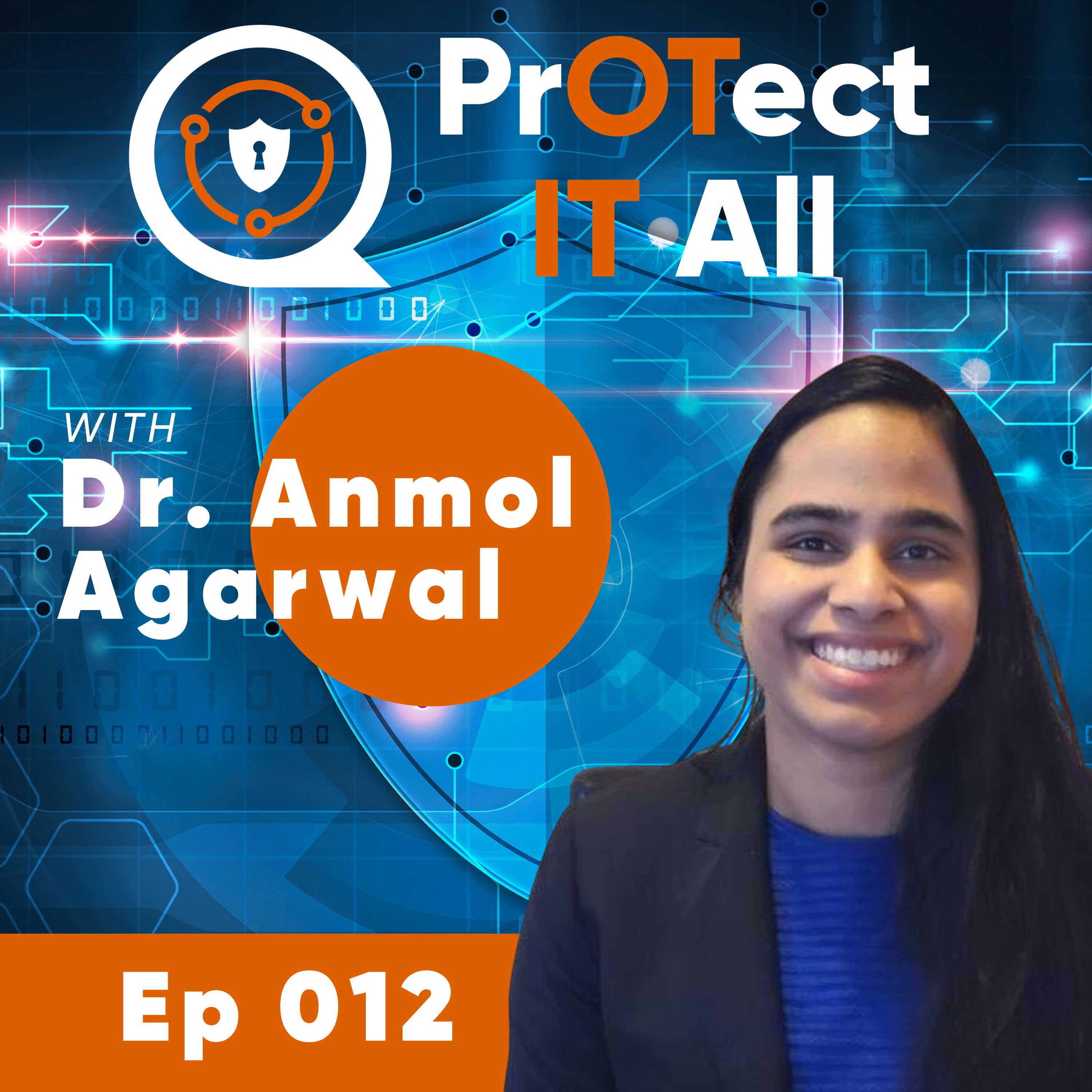
Episode 12
Interview
In this episode, our host Aaron Crow, sits down with Dr. Anmol Agarwal, a distinguished security professional at Nokia and adjunct professor specializing in machine learning. Together, they dive deep into machine learning, AI, and cutting-edge telecommunications technologies.
They uncover how vast amounts of data are crucial for training machine learning models to detect anomalies and prevent cyber threats, particularly in the telecommunications industry. Dr. Agarwal also sheds light on the transformative impacts of 5G and future 6G networks, from enhancing communication speed to revolutionizing smart manufacturing and industrial networks.
Explore the fascinating world of digital twins, AI-powered anomaly detection, and the complexities of transitioning from 4G to 5G. Aaron and Dr. Agarwal also discuss the global efforts required to standardize these technologies and emphasize the importance of diversity and passion in the tech industry.
Tune in as they tackle the current challenges and future possibilities in AI and telecommunications, and discover how these innovations are shaping the security landscape. Plus, take advantage of Dr. Agarwal's valuable insights and upcoming research on AI-based solutions to prevent DDoS attacks. Let's dive in!
Key Moments:
00:10 Old technology, like dial-up, latency is important.
04:08 Latency in IT and OT processes. Excitement for 5G.
08:40 Machine learning for anomaly detection, digital twins, network sensing for 6G.
12:54 5G as secure media pipe for communication.
15:43 Training machine learning models requires ample data.
18:14 AI benefits outweigh fear of job loss.
22:06 AI creates and replaces jobs, imperfect but beneficial.
25:34 AI adapts dynamically, opens limitless possibilities.
27:31 Live stream with CEO playing themed tabletop.
32:06 5G signal has shorter coverage than 4G.
36:42 Diversity in cyber is crucial for innovation.
40:37 Diverse backgrounds bring fresh perspectives to cybersecurity.
43:04 AI creating deepfakes raises concerns about misinformation.
45:01 Concerned about deep fake potential and solutions.
About the guest :
Dr. Anmol Agarwal is a security expert at Nokia, dedicated to securing advanced communication technologies such as 5G and upcoming 6G networks. Her critical work ensures that the data transmitted through your cell phone calls and text messages remains confidential and protected from hacking. Additionally, Dr. Agarwal imparts her extensive artificial intelligence knowledge as a part-time adjunct professor teaching machine learning. Her expertise not only safeguards our digital communications but also enhances their speed and efficiency through the innovative application of AI.
How to connect with Dr. Anmol :
LinkedIn: https://www.linkedin.com/in/anmolsagarwal/
X: https://twitter.com/anmolspeaker
Connect With Aaron Crow:
Learn more about PrOTect IT All:
To be a guest or suggest a guest/episode, please email us at [email protected]
Aaron Crow (0:0.878): Hey, I'm super excited. Thank you for joining me today. Why don't you introduce yourself? Tell us who you are, what you do and kind of all your background. I'm really excited to dive into this conversation.
Dr. Anmol Agarwal (0:9.578): Yeah, thanks so much, Erin, for having me. So I am a security researcher at Nokia and also a part -time adjunct professor, and I teach machine learning. So a lot of my work is related to securing 5G and 6G. Basically, think of 5G like with your cell phone. When you're making a call or you're sending a text message, you want that information to be secure. You don't want it to be hacked.
Dr. Anmol Agarwal (0:36.074): So my job is actually securing all of this technology for you. And that could also include using AI in order to make the phone calls and the text messages faster.
Aaron Crow (0:47.854): That's awesome. I mean, you're, you're, you're hitting on all the buzzwords that everybody's talking about right now from 5g to 6g to AI and machine learning. Like that is everything. Almost every one of my, my guests that come on, we're diving into this in some form or fashion. But I mean, the reason for that is because it has so much power to really, implant impact so many different businesses in so many different ways. So man, let's, let's dive into it. So let's dig in a little bit more about the, the convert 5g, 6g,
Aaron Crow (1:17.294): What is the impact? What is the difference between 5G, 4G, all this? Obviously there's a speed difference, but there's a whole bunch more that goes into that from how it works and what all can use it and what it can even be used for, right?
Dr. Anmol Agarwal (1:29.994): Alright, so I can give you a background. So you were right, speed, that's the big thing. We also talk about latency, lower latency. So you have faster download upload speeds. In terms of 5G and 6G, the big difference with 5G...
Dr. Anmol Agarwal (1:47.562): from 4G is that 5G is now being in multiple industries. So they're using it not only with a cell phone call, but they're using it in manufacturing for smart manufacturing, industrial use cases. And 6G research is actually what I'm working on right now. So we're trying to enable AI technology. So think of like metaverse, virtual reality, hologram ads, things like that. How do we actually...
Dr. Anmol Agarwal (2:17.386): create that and make it so fast that you actually think the hologram is right in front of you in real time. You don't want it to be buffering as you watch the ad. So that's really the big difference between 5G and 6G and 4G is we're trying to anticipate all this new technology and making everything faster and easier to use for users.
Aaron Crow (2:40.302): Yeah, I mean, I can, I'm dating myself here, but I remember back in the day when you had to plug in, if you wanted a decent connection, you know, your physical, I remember having to do dial -up right in the fastest internet you had was, you know, 14, four modem or 56 K modem, right? obviously I'm dating my myself and how long I've been doing this type of thing. But, but now you mentioned, so a lot of the work that I do is in operational technology. So infrastructure and manufacturing and critical infrastructure, that kind of.
Aaron Crow (3:8.110): And latency is the key, right? It's a very, they don't send a bunch of data. Like if I looked at a network, I can support, most industrial networks are 10 megabit networks, because they're not sending big packets. It's not video, it's not anything like that, but latency. They need it to happen very fast. I can't drop packets, I can't miss a packet. It has to happen instantly. Sub, you know, microsecond response times for some of these processes.
Aaron Crow (3:35.918): and latency is the, is evil. I can't, I can't do it. So some of the security, you know, security tools that work in an IT world, secure remote access and, and, you know, encrypting and encapsulating things, all those things don't, yeah, they add some latency in an IT world, but the processes forgive it. But in an OT world, those processes don't forgive it. Like you can't deal with that latency. I need it to be instant, instant, instant. So everything that I'm adding along the way, I have to be careful in what I do because of that. So,
Aaron Crow (4:5.774): I'm excited to hear about 5G and how that can open up. Cause right now a lot of the ways that you're doing things in power plants and manufacturing, I'm running fiber. You know, I did a power plant years ago where we were trying to do, you know, packet visibility and understand the networks, you know, and we spent a million dollars in a fiber footprint just because there's no other way to do it. Like I have to get power. I have to get network 900 foot from one side to the other and wireless again.
Aaron Crow (4:33.678): 15 years ago, there's no way I would trust wireless on a critical process, because it's going to drop packets and all the things. So it's exciting to hear how that's going to help us lift, because then it becomes a lot cheaper and easier to deploy instead of having to have this very hard and old school physical infrastructure to be able to deploy sensors and capabilities in these environments that are 100 years old, some of them, that I can retrofit them without having to upgrade the fiber plant.
Dr. Anmol Agarwal (5:4.106): Right exactly and that's something we're actively working on. So you mentioned OT right? So digital twins is something that we're thinking about in 6G is how do we actually have a digital twin? So for those in the audience who might not know what a digital twin is, just think of it like a digital copy or a digital simulation of a system in real life. So that could be critical infrastructure. We're thinking about using it for a power grid, some smart devices in a power grid.
Dr. Anmol Agarwal (5:34.060): And basically, you're just going to have a digital copy of the devices in that power grid. So that allows you to simulate different kinds of attacks or different use cases, different things that could happen on the device. And that's called a digital twin. So when we're actually doing these studies for 5G and for 6G, what we're trying to do is simulate this kind of digital twin. And we're saying,
Dr. Anmol Agarwal (5:59.818): okay if this attack were to happen how will the system behave in this case and so we're doing that simulation exercise to try to secure those devices and that's something 6g for example it takes 10 years so this is something it takes a lot of time and effort to actually do it's not something we could just do overnight but yeah that's definitely something we're looking at right now.
Aaron Crow (6:25.070): Yeah. And that's, that's interesting, you know, digital twins. So I've built labs for years as well for, for similar purposes, but a lot of the labs that I've had to build in the past, I'd have physical hardware, right? And some of the difficulties in, in, in securing and understanding OT is because I don't know how it's going to handle. So I, I can't, I can't do red teaming very, most places are not going to let me scan. I can't do a red team attack because that process is critical. And I don't want to, I don't want to have the there there's too much risk.
Aaron Crow (6:53.998): around causing damage or, or, or implement, you know, making the plant trip or whatever, I can bring it down. It's too big of a risk. So when you start doing a digital twin or I have a lab, a safe environment, then I can also beyond just being able to practice, you know, attack and, and, and defense, I can also understand what good looks like and what bad looks like. So if I understand what good looks like, then I can look for anomalies. Like this is what it should look like. And anytime, anything that's outside of this,
Aaron Crow (7:22.894): is bad. I assume it's going to be bad, or at least it's something I should look at and see if it's bad. But right now, so much of our OT environment and a lot of these, because they're so old and they're temperamental and they're sensitive, I'm hesitant. Most organizations are hesitant to do a lot of tracking, to do a lot of testing because they're scared of what's going to break. But adding digital twins, it opens up the world to be able to do a lot of things and understand.
Aaron Crow (7:51.502): what good looks like and how to protect in these environments.
Dr. Anmol Agarwal (7:54.890): Right, exactly. And you mentioned the keyword anomalies. So actually, everyone thinks of AI, right? So actually, they're trying to use AI now in digital twins as well. So anomalies is the keyword. So any anomaly, if you want to detect it, typically we use something in machine learning, or AI, for those who are not aware. Machine learning is basically, think of it like the back end of AI.
Dr. Anmol Agarwal (8:21.866): That's the easy way to understand it. So whenever you're using machine learning for anomaly detection, that will add some resource overhead, but we're using it for exactly this, digital twins, seeing any anomalies that might exist. And we're also thinking of doing something called network sensing in 6G. So network sensing, basically the idea is you have these devices in the network itself and you can have some kind of 6G
Dr. Anmol Agarwal (8:51.018): sense is what the marketing team is calling it, but basically it's like you have an ability to detect, okay, is this attack happening and what are the impacts to it? And exactly, it's just using digital twins to stimulate these kinds of attacks to also see what is good, what do we want to happen on the device, what is bad, what is not ideal, and to hopefully anticipate it and create some mitigations around it. So a lot of my research has actually
Dr. Anmol Agarwal (9:20.266): focused on that. And a lot of it is really difficult, right? Because you have to balance so many different things. You have to have low latency, also high reliability. And sometimes that is a trade off as well.
Aaron Crow (9:34.862): Yeah, and the other piece to this, you know, AI, I've been using AI for a while and, but OT is very slow to adopt, right? So new technologies come out 4G, 5G, you know, whatever the technology is, OT is usually very, very slow to, to, to adopt things. part of that is because of funding and well, there's, there's a lot of reasons, but let's get back to how can we,
Aaron Crow (10:1.518): Because I agree, like all of these things, I want to fast track this as much as I can. And I want to go as fast as it's safe so that I'm not introducing an undue risk in these environments. But some of the things that we're concerned around in OT is obviously I don't want to connect my power plant to the internet, right? I don't want somebody from China or even my next door neighbor to be able to connect into this thing accidentally or whatever, because it's really risky, right? I don't like to get into a power plant. There's a gate, there's a.
Aaron Crow (10:30.766): guard, you know, I have to wear PPE. It stands out. There's not that many people that work there. So even if I have all the right things, they know each other. So if I've never been there before, they're going to be like, who are you and what are you doing here? Right. So from a network perspective, we're, we're bypassing a lot of that. Cause if I can get to it from my house, whether my house is in Texas or Chicago or wherever it is, then that's, that's a risk that is, is scary for good reason.
Aaron Crow (10:59.598): And these technologies, when we say 5G, I think I know your answer and the answer that we're looking at in the industry is that doesn't necessarily mean that I'm doing 5G with AT &T. It just means that I'm using the technology and that technology can be owned by the company. It can be a private network. It can be encrypted end to end on a private network that's not connected to the internet. It's not connected to AT &T or T -Mobile or Verizon or any of these conglomerate.
Aaron Crow (11:29.422): So cell phone networks, but it's still the technology that is allowing the speed. And I think that's where we have to differentiate disconnect. Am I right in that? Just cause I say 5G doesn't mean that I'm on a cellular network. That's that's a commercially available network, right?
Dr. Anmol Agarwal (11:42.186): Yeah, you're right. Yeah, exactly. I mean, everyone thinks of 5G equals these major carriers T -Mobile, AT &T, Verizon, but you can actually use this technology in your systems without using them. It's not always cellular. And actually, Nokia will come out with a product. It's called Network as a Code. So if you've heard of it, it's basically
Dr. Anmol Agarwal (12:5.898): a way to use this technology in 5G and in 6G and you instead of having to code it and understand how exactly is this technology looking like at the back end, you can have your developers have a very easy almost drag and drop system that allows you to use this technology. And I know other companies are creating similar products as well. So yeah, definitely you can use this technology without using AT &T, T -Mobile, Verizon, et cetera.
Aaron Crow (12:35.278): And that that's exciting because that opens up so many doors because again, nobody is concerned about the the actual media. So I look at 5G is like the media. It's like Wi -Fi or Cat 5 or anything else. Right. It's really the the the pipe that I'm taking it across. If I own that pipe and it's encrypted and it's secure and all those kind of things, then I'm less concerned about the technology. And if it can get me the latency and I can add devices and I can support it and all of that, you know, power plants and power companies.
Aaron Crow (13:4.814): you know, all of the power lines you see across the country, you know, we've been putting microwave on those things to get signals long, long haul. Now, obviously latency is a huge problem there, but some of the divide, we would use that, that, that network for, for non latent, you know, latency dependent messages, right? So we'd get logs out, we'd get, you know, different things like that. But imagine if I replace those microwave, you know, repeaters along the way with a five G antenna instead,
Aaron Crow (13:34.382): then I can use that same backbone, that same network, but then I can do high latency required devices. Then I can start doing control. Then I can start doing all these other things. And again, I own the network. It's sitting on my pole. It's sitting in my power redundancy. You know, I'm not, it's not going to the internet. It's not going outside of my environment. So from a compliance perspective with regulation, I'm not having, I still own it all, right? It's not going to China. It's not going to AT &T or AWS or anything else.
Aaron Crow (14:3.022): then I'm more secure and more confident in those things. And I'm more likely to use something like that if I can kind of control it end to end.
Dr. Anmol Agarwal (14:10.986): Right, exactly.
Aaron Crow (14:13.134): That that that's super exciting. So let's dig into how AI is helping with some of these and doing those anomaly detections. Cause I mean, AI is, is I look at AI and machine learning as just a force multiplier, right? I can have a team of a hundred people, you know, digging through alerts and trying to find the needle in the haystack, the anomaly that we talked about earlier, or I can tell, I can start training AI to do some of those first level things for me. And then I have a smaller team that,
Aaron Crow (14:42.702): I'm just looking at the alerts that AI catches and sends to me. So instead of looking at thousands of alerts a day, maybe I'm looking at 50 and those 50 have already been prioritized based on the things that we're teaching AI, right?
Dr. Anmol Agarwal (14:53.354): Right, yeah, that's one way to use AI. So let's focus on anomaly detection, right? So exactly what you were saying, Erin, exactly that. But so in machine learning and AI, people tend to think of it like a magic solution. But I always say it's just, you know, data analytics. So it's just a way to analyze your data. And right, if you have thousands of alerts, you can't you can have maybe a team of thousands of people to look at each alert, but that's not practical.
Dr. Anmol Agarwal (15:22.186): So that's why you want to use machine learning. So machine learning, what you're doing when you train the model is you need enough data to actually train the model.
Dr. Anmol Agarwal (15:31.722): that's something in the industry that can be hard to do, but what you need is you need a lot of data to give your algorithm so that it can actually learn. If I see this pattern A, then I know this might happen. To actually see these kinds of patterns, it needs to learn from a lot of different data. So not just what you're looking for, but also any data that you're not looking for. You need to look at all the different types of scenarios that you might anticipate. That's
Dr. Anmol Agarwal (16:1.628): that's really what you're using machine learning for. And anomaly detection is probably one of the most popular ways you're using machine learning, but people are also using AI and machine learning in telecommunications to prevent against.
Dr. Anmol Agarwal (16:19.914): cyber security attacks that we might see with intrusion detection systems, intrusion prevention systems, they might also be using machine learning and AI. And again, whenever you have data, machine learning is just analyzing the data. So really any scenario you can think of where you have a lot of data and you don't know what to do with it, or you're not sure what it all means, then you can apply machine learning and AI to that.
Aaron Crow (16:47.374): Yeah, using using that to find that needle in the haystack, right? And being able to crunch more data than a human can look at. And we've all we've also seen those, you know, the phishing attacks where the, the website, the address looks, you know, amazon .com and you look at it from the human eye, it looks the same, but it's actually using a different, like, you know, so relic, alphabet instead of, an English one. And it's actually going to another website, but.
Dr. Anmol Agarwal (16:50.698): Right.
Aaron Crow (17:15.662): me looking at it, it looks good, it looks fine. And I click on it and it goes, it goes to not Amazon. It goes someplace else, right? And obviously a machine can see the difference between those two things, right? Little things like that, that, that humans are not going to potentially catch. We're good at seeing patterns, but, but obviously we're limited by, you know, maybe we had a rough morning or we didn't drink enough coffee or whatever the thing is. I, I didn't sleep well last night or I've seen a thousand of these and I, I, I clicked.
Dr. Anmol Agarwal (17:22.698): year.
Aaron Crow (17:44.046): Okay, twice instead of once. So I skipped one and that one that I skipped was actually one I should have dug into. you know, machines don't get tired. they, they, they don't have a bad night. They don't, they, they're not hung over. They don't, they don't get the flu. You know, they, their girlfriend didn't break up with them. Like they're just looking at the data all day long, all night long. So the more data that you send it, the more, the more happy it is. which is really cool. The other side of this is, is beyond just, you know, looking for bad actors and bad guys.
Aaron Crow (18:13.934): We can also use this to look for good things. Like I can help it to do tuning. I can, I can help it to make things more efficient from power use to, you know, CPU cycles and configurations. And there's all, you know, looking at my code there, there's a lot of things that we can use this for that are very beneficial. And a lot of people are on the fence around, you know, AI and you know, it's going to be the Terminator and they're going to take over the world and it's going to get rid of jobs and all those things. Yeah. Okay.
Aaron Crow (18:43.342): Yes, it's going to eliminate some jobs, but I think it's going to make other jobs, right? It's, it's jobs are going to be different. It's yes, it's going to eliminate some jobs. Absolutely. But it's also going to open up a hundred more jobs that look different, right? You're just doing a different thing and you're using, cause I don't see a place at least in, in, in the near future where AI is just going to be able to do everything on them. Like I use AI all the time and Hey, create me a diagram or a drawing or something like that. And it's really good at some things. And then other things that are so basic, like just text.
Dr. Anmol Agarwal (18:44.266): Yeah, I agree.
Aaron Crow (19:13.166): text in Dolly trying to make an image, it's really bad at it.
Dr. Anmol Agarwal (19:17.578): Yes, yeah. Well, it's interesting you brought up the phishing email. So a lot of people are scared of AI right now, because people are actually using AI to craft different attacks. So people are using generative AI like ChatGPT and saying, create a phishing email for me, or create this phishing email with this text and
Aaron Crow (19:21.038): It's funny.
Aaron Crow (19:31.182): Mm -hmm.
Dr. Anmol Agarwal (19:41.194): chat GPT or generative AI can create an email that's more convincing than what they might have done. So they might be able to correct any misspellings or get rid of any emojis, make it more convincing for us, and then we're more likely to click it. But
Dr. Anmol Agarwal (19:58.314): yes, we're also using AI to detect these phishing emails. So Gmail, for example, whenever it says this might be spam, this might be a phishing email, then it actually flags it and puts it in your spam folder. So with every good innovation, there is a negative side, but I think with AI, the positive outweighs the negative because there's so many things you might not realize it, but we're using AI every day, even if you're not in tech, right? So even
Dr. Anmol Agarwal (20:28.362): going on Hulu, Netflix, Peacock, whatever streaming service you want, you're using machine learning in order to do that. Because whenever it tells you, you might like this movie, that's machine learning. It's getting the data from your user preferences or from people in your area or someone signed into your account, right? It's saying, okay, we see all these users are using this.
Dr. Anmol Agarwal (20:53.706): this account or they like everyone who likes this action movie also likes this other action movie. So that's a way, you know, AI is being used everywhere. You know, banks are using AI too with chat bots, with creating even for their fraud detection, they're using machine learning that, okay, this check.
Dr. Anmol Agarwal (21:15.306): might be suspicious and they're actually using AI to say, okay, this check is suspicious. We think this is a suspicious transaction. We'll flag this as an alert. So maybe people don't realize it, but any innovation.
Dr. Anmol Agarwal (21:32.458): that we're seeing a lot of it is AI driven. So it's not the Terminator. Just think of it like an innovation, right? It's like industrial revolution, right? Some jobs went away, but we have new jobs now. So even though a lot of jobs might be going away, it's like the jobs that are going away are the ones that are easily automated, but there are so many other jobs. And I think actually,
Dr. Anmol Agarwal (22:1.994): there was a website, World Economic Forum, they actually said long -term AI is going to give you more jobs than the amount of jobs it's taking away. And we're already seeing that now. Like if you look...
Dr. Anmol Agarwal (22:15.754): on LinkedIn or on any website, you'll see prompt engineering jobs and they're paying a lot of money. They're paying like $200 ,000 a year. And that's just create a prompt for ChatGPT, be able to type in a question to ChatGPT so it gives us the answers we want. But yeah, AI is not good for everything. Whenever you generate an image,
Aaron Crow (22:20.302): Mm -hmm.
Dr. Anmol Agarwal (22:39.978): Like for example, when I try to generate an image of a person for my slides, the hands are always off. The hands are like not, it's not these five fingers. It's like three fingers or six fingers. So yeah, so AI is good, but also it's not perfect and it's just a way to analyze data and see patterns and helps automate certain things, but it's not going to take over humans anytime soon.
Aaron Crow (22:49.486): I'm sorry.
Aaron Crow (23:9.230): I agree. You know, that, that, that spart some, something for me is, is we, we've used, I'm working with a company called threat gen and they do, they created this AI auto tabletop product, right? And the reason I bring it up is because AI can be used in a lot of different ways. So we can use it for anomaly detection. We can use it for, you know, enhancing and looking for how to, how to make things run better, looking at code and, and you know, misspelling.
Aaron Crow (23:37.870): things. you know, I, I can create a post and a blog post or whatever. I create all the content. I do a data dump of all the things that I want to say. And I don't necessarily have to worry about how to format it. I can dump it into chat GPT and say, Hey, format it in this format. I want to be a post. I want all of this text to be, you know, put into six paragraph, whatever I want to say. And it dumps it back out of me. It's my original thoughts. It's just formatted by AI instead of me focused on, on doing that, which.
Aaron Crow (24:6.286): Microsoft Word does the same thing. Like, hey, this is a fragment. This is misspelled. Like it's just doing that same thing. It's just faster than having to manually type it all. Right? So the auto tabletop that I'm talking about, it can be used for training purposes. So imagine you talked about the digital twin earlier. In addition to all the benefits that we talked about already, the other thing is, is I can do training. So I've got this safe environment that I can then turn my, my sock analysts or my cyber.
Dr. Anmol Agarwal (24:14.954): Right.
Aaron Crow (24:35.150): my engineers, anybody, I can turn them loose in this environment and they can play. They can, they can, you know, misconfigure it. They can try to attack it. They can take it offline and they can see how the system responds. Like what messages do I get? Did I see the attacker coming in? You know, did, did I see somebody change the configuration of the firewall? Like all of those things. And I can train that on the tabletop. Most tabletops that I've experienced in my career have been.
Aaron Crow (25:2.702): once a year, they've been analog, you know, in a conference room on paper. and I've already determined all of the steps before I ever walk in the room, whereas this is dynamic. It's on the fly. So if you come up with a really great, you know, we get to step two and you're like, yeah, but that's not how we would do it. We would do it this way. You can give it that response and it'll dynamically adjust. So it's like a choose your own adventure instead of this static reading the book. And every time you read the book, you get the same answer.
Aaron Crow (25:31.854): page 10 is page 10 every time I can use AI to think on the fly. I can give it configurations. I can give it, you know, architecture diagrams and all this kind of stuff. That's another great way that I can, I can see. And if 5g and 6g for me opens that up too, because if I can take a copy of everything that I have and duplicate it into a digital twin on the fly real time or at least near real time,
Aaron Crow (25:59.918): then imagine how much better my staff can be. Like I can train my people better. We can learn better. I can, I can point AI at it and say, start, start, you know, analyzing this from now until, you know, whenever, and when something changes, let me know so I can start looking. There's, there's just, the possibilities are unlimited. When I, when I opened the bridge, cause right now, one of my bottlenecks is network and bandwidth and latency. If I fix those things, then I open Pandora's box to be able to do a lot more capabilities.
Aaron Crow (26:28.622): and my data becomes a commodity. Data is more like an OT like it is an IT today, where I can send almost unlimited data to the cloud. Obviously I have to pay for it, but there's no, the bottleneck is financial, not bandwidth. Whereas in OT, it's still a bandwidth and latency issue, but 5G and 6G has the opportunity to lift that up. And then AI added on top of that, it's a 10X multiplier in OT from what I see.
Dr. Anmol Agarwal (26:53.418): Okay, that's really interesting. Yeah, most of the tabletop exercises I've been to have been very manual. It's like you're in a conference room, you have the red team, the blue team, you have some managers in the room, and they just have an excel spreadsheet that they fill out. So yeah, that's really interesting.
Aaron Crow (27:9.422): Yep. Yeah, we, we even did them. the first one we did, we did a live stream. I did it with the founder, the CEO of the company and we, we streamed it to YouTube. and we actually played, we did a themed version of a red, of a, of a tabletop and, and it was star Wars themed and we were, we were on the Death Star and the rebellion was doing a cyber attack against the Death Star and we were having to defend.
Aaron Crow (27:35.022): the Death Star against the rebellion. So we were deploying cyber security and sending storm troopers and, but it was still cyber related. So it was more fun. It wasn't as dry, but I was still, you know, you can see how you can still get the message across. You're still doing the cyber basics. You're still following your run books, all that kind of stuff. You're just having fun with it, right? It's a lot less dry and people aren't, aren't dreading it. I can start in making it more available to, to more people.
Dr. Anmol Agarwal (27:54.698): Right.
Aaron Crow (28:1.966): So I'm, I'm better trained. I can have more people involved and make it more fun than more people are like, yeah, let's go back. Let's do another one next month. And next month, let's do, you know, the wild west or, you know, football or, or badminton or whatever the thing is, you can make the themes unlimited by, but still the core of the message and the learning is still the core principles of what, what you're trying to teach your, your, your staff.
Dr. Anmol Agarwal (28:26.026): Yeah, that's really interesting. Yeah, because whenever we talk about telecommunications, if we don't make it fun or if we don't have examples for people, then they're just lost like, we don't care. So yeah, definitely. That's, I mean, that's everywhere in technology. You need to make it engaging for everyone because otherwise no one's going to really pay attention. And so whenever you have a new product, yeah.
Aaron Crow (28:39.150): Well that, that's what, yeah.
Aaron Crow (28:48.846): We've all taken the class where the instructor is super smart, but they're dry and you just fall asleep. Like, you know, you can't pay attention. It doesn't matter how intelligent the person is. It's not enjoyable. So it's almost impossible as a human to pay attention for very long. The more engaging we can make it, the more entertaining we can make it, the more likely more people will pick up on it and it'll be more widely adopted and people will stick with it and all that kind of thing. So let's make it fun. It doesn't have to be dry.
Dr. Anmol Agarwal (28:54.858): Right. Yeah.
Dr. Anmol Agarwal (29:4.234): Right.
Dr. Anmol Agarwal (29:13.258): Yeah. Right, yeah.
Aaron Crow (29:18.574): So what are some of the biggest hurdles that you see overcoming that you'll have to overcome in 5G or 6G adoption or from a architecture or engineering perspective, especially related to cyber and even in OT.
Dr. Anmol Agarwal (29:32.650): Yeah, that's a really good question. So it's going to be a multi -part answer. So I think in terms of research, the biggest challenge we see in research right now, like I mentioned, 6G is coming out in 2030. It's going to be very difficult for us to anticipate how exactly is AI being used right now. So we see...
Dr. Anmol Agarwal (29:56.202): We see, for example, we see the metaverse is a big trend we see, but it's really difficult to actually see how is this going to look like in 2030. So whenever we develop these standards, because I'm on the standards team and we're saying, OK, we want to standardize 5G that all the operators like T -Mobile, AT &T, Verizon, Huawei, all of these different companies all over the world, they should use 5G the exact same way.
Dr. Anmol Agarwal (30:23.242): And so that's a challenge is how do we collaborate with these global teams and say, yes, all of us agree 6G is going to be exactly like this. And so that's really the biggest challenge we see in research is because it has to be a global collaborative effort. And so it can't just be the US interests and forget about.
Dr. Anmol Agarwal (30:45.258): Europe or China because even China is actually involved with these standards. So sometimes you know that involves
Dr. Anmol Agarwal (30:53.610): a collaboration and cooperation with all these different countries. So that can be a challenge. And then in terms of other hurdles that I've seen in 5G and 6G is, you know, 5G has been out, but a lot of people still don't have access to 5G, right? Because they have to actually create these cell phone towers, you know, they have to phase out 3G, 4G and replace it with 5G. So maybe when in 2030, when we see 6G coming out, maybe then people will have
Dr. Anmol Agarwal (31:23.516): more access to 5G and they might not have access to 6G right away, but we have to not only research it and create the standards and create that technology, but actually deploying that technology does take time just because it's so involved and sometimes can be really resource intensive. So that's really the other challenge that I see.
Aaron Crow (31:45.998): from, I know one of the issues I've heard is with 5G is it can support a lot more bandwidth, but the 5G signal doesn't have the same, the distance that a 4G does, right? So I can have one 4G tower and it covers more, you know, a diameter bigger than a 5G tower will, which means I need more 5G towers to cover the same area as a 4G tower. So that's why what I've heard in a lot of heavily populated areas, you know, big cities, et cetera, you're gonna get 5G.
Dr. Anmol Agarwal (31:57.706): Yeah.
Dr. Anmol Agarwal (32:7.306): Right.
Aaron Crow (32:14.126): But when you go out in rural America, I'm less likely to get it unless I'm on like a major highway or something like that. When I get off in the sticks, I'm less likely to have 5G. What about 6G as far as the coverage, et cetera? Is it similar to 5G or? Okay.
Dr. Anmol Agarwal (32:28.170): So we're not sure yet. We're thinking it's similar to 5G, but right now it's just what do we think 6G will look like. So we're not going to define that until probably 2030. But right now, based on the discussions, I can tell you it's going to be similar to 5G.
Aaron Crow (32:48.878): Sure. Yeah, and by that time, hopefully we have better, you know, wider adoption of the 5G. So especially if it's similar to that, then the transition could potentially be easier. And that's the other good piece is, you know, you definitely want, especially the world is so much more accessible now than it was, you know, 50 years ago, a hundred years ago. You know, I can be in London today, you know, on a plane, right? And I want my phone to just work wherever I go, whether I'm in...
Dr. Anmol Agarwal (32:54.154): Right.
Dr. Anmol Agarwal (33:13.642): Mm -hmm.
Aaron Crow (33:17.262): you know, the Middle East or Asia or wherever I'm at, I want my phone to just work. Now, maybe I need to pay my provider for the rights to be on that network, but still, I don't want to have to exchange hardware. It should work wherever I go. So that's a super important piece to this, like you said, with 6G is really making sure that we do have a standard that works across the globe, because all in all, we are all the same.
Aaron Crow (33:46.190): We're on the same planet. Like the difference between, you know, here in Asia from a technology perspective, yes, we're different countries and we have different, you know, religions and all that different stuff. But from a technology perspective, we're a lot closer together than we ever have been in history. So those are big reasons to make sure that we're working together, not against each other in those ways as best we can, obviously.
Dr. Anmol Agarwal (33:47.754): Yeah.
Dr. Anmol Agarwal (34:11.850): Right, yeah, whenever we develop any standards for 3G, 4G, 5G, and now 6G, it's always a global collaborative effort, which people might not be aware of, but it's not only the US and Europe, but also Asia, right? India, China. So we have not only Nokia, but also AT &T, Verizon, Orange, which is a French carrier. Just all of these different companies have to all agree on.
Dr. Anmol Agarwal (34:37.610): yes, 5G, we agree that it will look exactly like this, or 6G, we agree it will look exactly like this. And sometimes we have options, right? Maybe in China, they want to do it one way. So we have an option for China, and then we have an option for the US. But ultimately, we're all on the same planet, and we all have to agree that, yes, 5G and 6G will be like this, and everyone in the world will have access to it. So yeah.
Aaron Crow (35:4.814): Yeah, that's awesome. I mean, I'm going to go to, I'm going to go to dinner with my wife after this for a date night. And it's hard enough just to, for us, the two of us to decide where we're going to go to dinner. So I can't imagine trying to convince people from all over the world in multiple countries on a technology as complicated as six G's. So thank you for all the work that you're doing. I applaud you for that.
Dr. Anmol Agarwal (35:25.578): Yeah, it's like six meetings every year in different countries. So six meetings, just imagine traveling to six different countries every year and having a discussion. And then that's like one version. And so like this happens multiple years to actually get it standardized. So yeah, it's a lot of back and forth.
Aaron Crow (35:34.766): Mm -hmm. Right.
Aaron Crow (35:42.638): Right. Yeah. Yeah, exciting stuff. So how, how obviously looking at your LinkedIn and the stuff that we talked about before, I know one of the other things that you're extremely passionate about is women in cyber and getting more women into, into technology spaces. So talk a little bit about your experience as a woman in technology and the pros and cons and why you do it. And you seem to be very excited and passionate about, about the work that you're doing. So.
Aaron Crow (36:12.206): I love to give you an opportunity to chat about that and talk about opportunities for women to get in, like why you're in it and why you love it and all that kind of stuff, right?
Dr. Anmol Agarwal (36:21.354): Yeah, so I think one thing is that women in cyber or really we need anyone in cyber. We need everyone in cyber. We need not just women, but really anyone in cyber. If they're interested in it, we need more people in technology because to solve these challenging problems, you need to see the problem from different perspectives, right? Maybe you and I were both in the US and we might need people from other countries to provide their perspective on this challenge as well because we're seeing that with a
Aaron Crow (36:28.046): That's true.
Aaron Crow (36:36.430): Agreed.
Dr. Anmol Agarwal (36:51.260): AI, it's really biased towards the English language and it's not accounting for foreign languages. So yeah, definitely we need diversity in cyber. And I think especially for women in cyber, so I have mentored a lot of women and a lot of women are scared to enter cyber because they say,
Dr. Anmol Agarwal (37:11.690): we won't belong there. We don't belong there. There's not a place for us, right? So I try to tell everyone that we need everyone in cyber. We need your perspectives as a woman in cyber because you might solve a challenge in a different way. You might have a new idea. If you think about it, research is all about new ideas, thinking outside the box. And so we need people to be able to think outside the box like that. So definitely.
Dr. Anmol Agarwal (37:39.082): I would say if there are any women listening to us or watching today, don't be scared of following your dreams. If technology is something you're passionate about, go for it. Don't listen to people when they say you don't belong here because you do. And cyber, there's so much to it. We're talking about OT and IT, but there's so much to it. So maybe you're a teacher.
Dr. Anmol Agarwal (38:3.466): want to go into cyber, you can. There are so many different jobs. There are governance, risk, and compliance. There's project management. There's red team, blue team, designing, coding. So there's so much in cyber. And I would say pretty much anyone could enter the field. It's just
Dr. Anmol Agarwal (38:23.594): figuring out what it is you're passionate about and then pursuing that and pursue what you're passionate about. And don't really listen to people when they say you can't do it because you can.
Aaron Crow (38:34.862): Absolutely. I 100 % agree with everything you just said. I have three kids. One of them is I have a daughter. I tell her the same thing, right? And I tell my son the same thing. It doesn't matter. Don't listen to other people. Go into what you want. And we talked a little bit earlier about AI, replacing jobs, et cetera. This is a prime example of something that we're going to need more jobs. The more AI and the more technology that we do,
Aaron Crow (39:0.366): the more gaps that we have in the marketplace, right? Is we have more roles that we need than we can fill. And to your point, I've always, I've had lots of very large teams and diversity and thought, that's the point, right? It's about diversity and thought, right? Is I don't care what color you are, what race, nationality, any of those things. I want people that are excited about the job, that are coming in and not afraid.
Aaron Crow (39:27.918): to tell me their opinion, not afraid to challenge me. Like I, I, I'm, I'm a tall person. I'm, I'm intimidating, you know, I'm loud. I have a beard. I'm six foot two. I'm 220 pounds, but I want people that are okay to challenge me. Right. I've been doing this a long time. I have a loud voice, but I'm not always right. I don't always know. I know what I know, but that doesn't mean that I know everything. It doesn't mean always know best, right? Is, is we need people that are willing to challenge. They're willing to stand up and, and.
Aaron Crow (39:57.390): to the women that are, or anyone for that matter, that think cyber's not for me or I don't fit in there. I challenge that, right? As I think, you know, I interviewed a guy the other day and he was a mechanic, an auto mechanic and got into cybersecurity, doing cybersecurity focused on vehicles, right? And he took this non -traditional path, did he get into cybersecurity, but he absolutely fits. Like I've had guys that were,
Aaron Crow (40:25.294): you know, power plant operators that transitioned into, into this, like it doesn't matter what your background is. It matters. Do you have a different perspective? Are you passionate about, is it something that you're willing to put in the work for? We need more people in this field that have that diversity of thought and diverse, you know, being willing to look at it outside the box and not just take the status quo because Aaron or somebody else said it was this way. Well, have you thought about this? Right. And, and being that school teacher will give you a,
Aaron Crow (40:54.606): a different perspective than me being in cyber for 25 years and all the experiences that I've had, they're biased to the experiences that I've had where you've had different experiences. So I definitely look, it's one of the reasons why I brought it up. It's one of the reasons I volunteer at, you know, ICS Village and building cyber security because we need more people in this space. And there's, there's, it's a really good space to be in. There's a lot of potential growth. There's a lot of opportunity.
Aaron Crow (41:21.352): whether it's starting your own business or, or, or being a consultant or, or, or doing product development or a programmer, or there's just so many opportunities for this space for women and diversity and, and just everybody to get in and, and the more people that are, that we can get here, good folks that can help fight the good fight. definitely come on over. Yeah. Okay. So we just said a lot what I'm going to close out with in the next five to 10 years.
Dr. Anmol Agarwal (41:39.082): Right, exactly. I agree with everything you said. Yes.
Aaron Crow (41:49.998): What is something that maybe you see coming up over the horizon that you're excited about and what's something that maybe you're concerned about if that we need to do something or it could be a problem.
Dr. Anmol Agarwal (42:1.194): Yeah, so I'm going to talk about AI. So I'm really excited about 6G and what 6G is going to look like in 2030. That's six years from now. What is that going to look like? Will we have like holograms in the future and like the metaverse? How is that going to work? Because that's something we're actively looking at 6G is.
Dr. Anmol Agarwal (42:21.066): maybe everyone's going to interact with avatars and maybe that's something we need to use 6G for. So that's something really exciting for me. But I'm also very scared of some of the different kinds of attacks that AI might be able to do because we're seeing that now with AI. People are using it like we talked about to craft different attacks.
Dr. Anmol Agarwal (42:43.498): And one concern for me is this idea of misinformation and disinformation because people are now using AI to create deepfakes. You might've seen on the news, people are able to pretend to be, for example, President Biden and say, create a video that makes it seem like he's saying things when he's not actually saying those things. And people are able to create AI images of, for example, Taylor Swift and
Dr. Anmol Agarwal (43:12.746): create explicit images of her, right? Which aren't real, but people are basically using AI now and generative AI in order to create fake images or videos to misinform the public and to make us think something that isn't true. So that is something I am concerned about. But I think, again, overall, there are a lot of positives with AI. We just need to be vigilant with, okay, this doesn't seem real or something's not quite right here.
Dr. Anmol Agarwal (43:42.378): and just pay attention to that feeling.
Aaron Crow (43:45.792): Yeah, and that's where we can use AI to protect against AI, right? And that's where information is important, right? You can't just assume, you know, you got to check your sources A and B, like we said earlier with the website, you know, it looks the same. Are you sure? Like, does it seem like something that would be that way? And maybe there's ways that we can use AI and tools to, you know, run through, is that an AI generated video? Right now, the video or a lot of the images that you see,
Dr. Anmol Agarwal (43:49.066): Yes, exactly.
Aaron Crow (44:14.830): people using, you know, just normal stuff using like open AI and Dolly for images. Nine times out of 10, I can spot it from a mile away just because they, they seem to make the same type of images and it doesn't matter what it is. I could, that's an AI generated. It's not a bad thing. I can just notice where it came from. But to your point given enough, I mean, I do this podcast. I did what 50 episodes last year. There's hours and hours of, of me talking and on video. So somebody could take all of that and create a deep fake of me.
Aaron Crow (44:43.790): saying whatever they wanted to, because I've got plenty of examples of content with my voice and how I talk and the words and the language that I use and my mannerisms and my facial expressions. So obviously they could create a deep fake with that. So yeah, that's definitely something that I've got on my radar as well. That's definitely something I'm hoping we find some solutions for pretty soon. So all that to say, thank you so much for coming. What is a call to action? What does somebody, if they want to reach out to you, maybe they want to get into cyber,
Dr. Anmol Agarwal (45:6.154): All that to say, thank you so much for coming. What is a call to action? What is somebody, if they want to reach out to you, maybe they want to get into cyber, they want to find you speaking somewhere, all that kind of stuff. Why don't you give us some of that? Yeah, thanks so much for having me. The best way to reach me is LinkedIn. So find me on LinkedIn. I'm also on X.
Aaron Crow (45:13.102): They want to find you speaking somewhere, all that kind of stuff. Why don't you give us some of that?
Dr. Anmol Agarwal (45:25.418): and I'll provide that information to you. That's probably the best way to reach me. I do provide free mentoring sessions to anyone who wants to get into cyber, so feel free to reach out. And then as far as what I have coming up, I do have a paper coming out the end of May at IEEE Smart Nets. We're basically going to propose a solution that uses AI and machine learning to prevent DDoS attacks in 5G and 6G. So that's something coming up that I'm really excited about.
Aaron Crow (45:56.686): Outstanding. Yeah, we'll definitely put those links in the show notes, folks. So you're welcome to click on there and reach out and get those that met that mentoring session that don't don't don't take that lightly. Like that's a big, big opportunity, folks. So if you're looking to get into the space, you've got questions, you're excited about 5G or AI or or whatever. Definitely, definitely hit hit her up for that. Same goes for me. If you all have questions or want to reach out, I definitely do the same thing. So so.
Aaron Crow (46:23.150): Thank you for your time today. I really enjoyed the conversation. I'm excited to see what comes out with 5G and read your paper as well. So thank you for all you're doing and I look forward to meeting you in person one day.
Dr. Anmol Agarwal (46:35.082): Thank you.
Transcript lightly edited for readability.
Subscribe to PrOTect IT All and stay ahead of the threats targeting critical infrastructure.