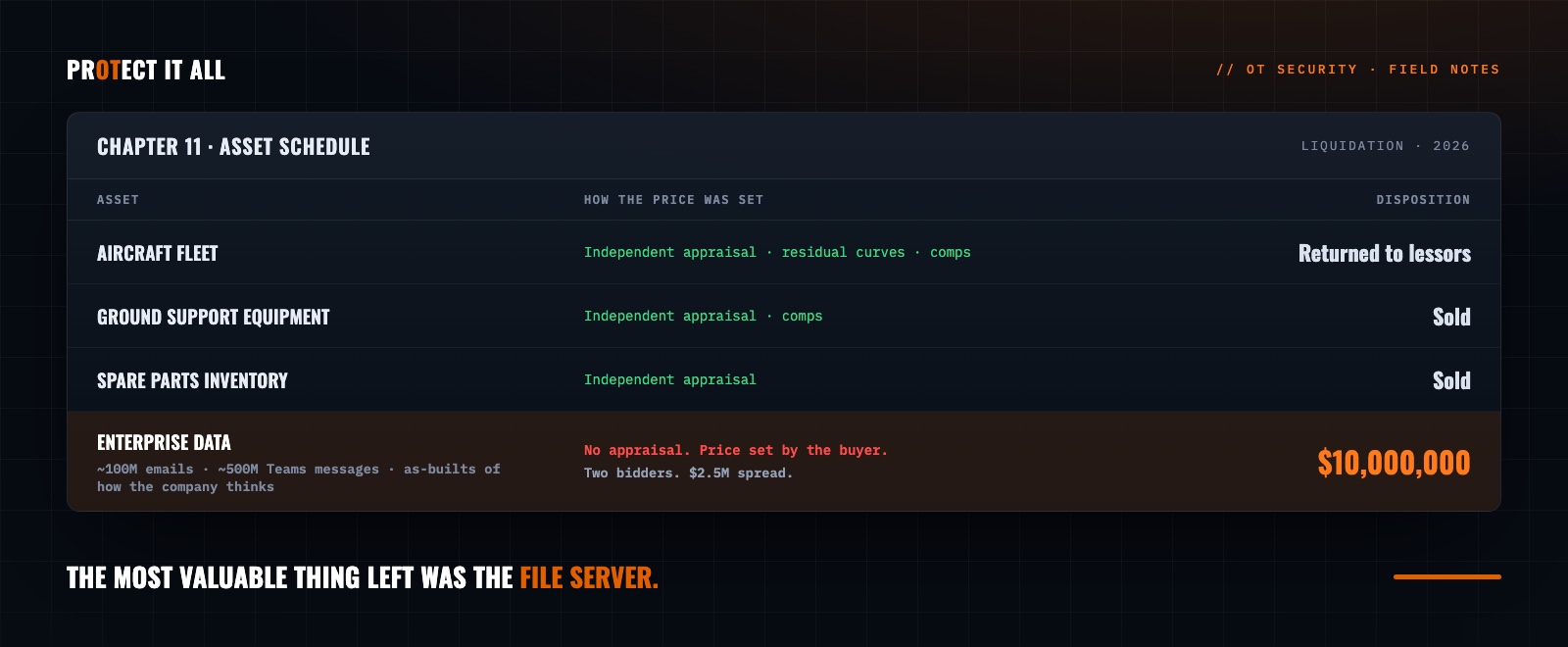
Picture the end of an airline. Not the headline version, the physical version.
The planes go back to the lessors. The gates go dark. The tugs, the belt loaders, the spare parts inventory, all of it gets tagged, appraised, and sold. Spirit Airlines halted all operations in May 2026, the first significant US airline in 25 years forced to stop flying entirely instead of being absorbed by somebody else. It has been selling itself for parts through Chapter 11 ever since, against roughly $8.1 billion in debt.
Here is the part I did not expect. The most interesting asset in the whole liquidation was not an airplane.
On August 17 it came out that Google agreed to pay $10 million for Spirit’s enterprise data. Roughly 100 million emails. Roughly 500 million Microsoft Teams messages. HR documents, project management files, financial databases, audits, presentations, calendars, spreadsheets, operational records, flight pricing records. An AI company called Mercor was the next highest bidder at $7.5 million. Two bidders, a $2.5 million spread, and a price that is a rounding error against that debt. CNN has the story.
Google says the data will be “rigorously scrubbed of any personally identifiable information by a third party before receipt,” and a court filing says it will be de-identified so it cannot be re-associated with individuals. Reporting conflicts on whether booking and frequent flyer data is even in scope. A Google spokesperson called it “part of an enterprise dataset from Spirit Airlines, which can be helpful in improving our products and AI models.”
And I want to be clear up front, because a lot of people are writing the angry version of this article. I am not mad at Google. What they did appears legal, arguably smart, and arguably good for Spirit’s creditors, who will take every dollar they can get. My question is different.
What happens when the next estate on the block is the integrator who has your project files?
Your data outlives your vendor
Picture a twelve person integration shop that has done your controls work for fifteen years. They hold your as-builts, your PLC project file backups, a VPN config, and nine years of email where somebody once pasted a password because it was faster.
Now picture that shop not making payroll. Not breached. Not hacked. Just out of money. The doors close, a lawyer files a petition, and every hard drive in that building becomes a line item on an asset schedule.
Because here is the thing about bankruptcy. It does not delete anything. The servers still spin. The mailboxes still exist. And once a company is in Chapter 11, the people running the sale have a fiduciary duty, and that duty runs to creditors. Not to customers. Not to former employees. Not to you.
That is the sentence I would put on the wall. The estate works for the creditors.
Your NDA, your master services agreement, your data handling addendum that took four months and two rounds of legal to negotiate, all of that is now a piece of paper competing against a very large debt number in front of a bankruptcy judge. Contracts in bankruptcy can be assumed, assigned, or rejected. I am not a lawyer, and this is a conversation to have with yours, but do not assume your paper protects you the way you think it does.
Nobody actually knew what it was worth
Attorney Michael McLaughlin, co-author of Battlefield Cyber, made a sharp structural point about this case that I have not been able to shake.
Every other asset in the Spirit estate had a process behind the price. The aircraft had independent appraisers, published residual value curves, comparable transactions. Somebody who was not the buyer and not the seller produced a defensible number.
The data had none of that. There was an inventory. There was no appraisal. The price got set by the only participant in the room who could model what the asset would produce downstream, and that participant was the buyer.
Inventory is not appraisal. We know that one in OT. A device list is a list. Knowing whether it matters when a thing goes away is the work.
We have seen this movie from the other direction
We wrote about advisory AA26-097A recently, where Iranian-affiliated actors were going after PLC project files. Not to cause a bang. To take the files, because the project files are the process knowledge. The logic, the setpoints, the interlocks, the accumulated decisions of everyone who ever tuned that system.
The Spirit sale is the legal mirror image of the same lesson. Process knowledge has a market price now. Adversaries steal it. AI companies buy it in open court. Either way, somebody other than you ends up holding how your operation thinks.
The OT translation
Look at what Google valued. Not the planes. The emails. A hundred million messages are how an airline actually thinks. How it prices, how it schedules, how it negotiates, how it talks internally when something goes wrong at 2 a.m.
For your organization, the equivalent corpus is how your plant thinks. And a large chunk of it is not in your building. It is at your integrator, your OEM service partner, your remote monitoring provider, your engineering firm.
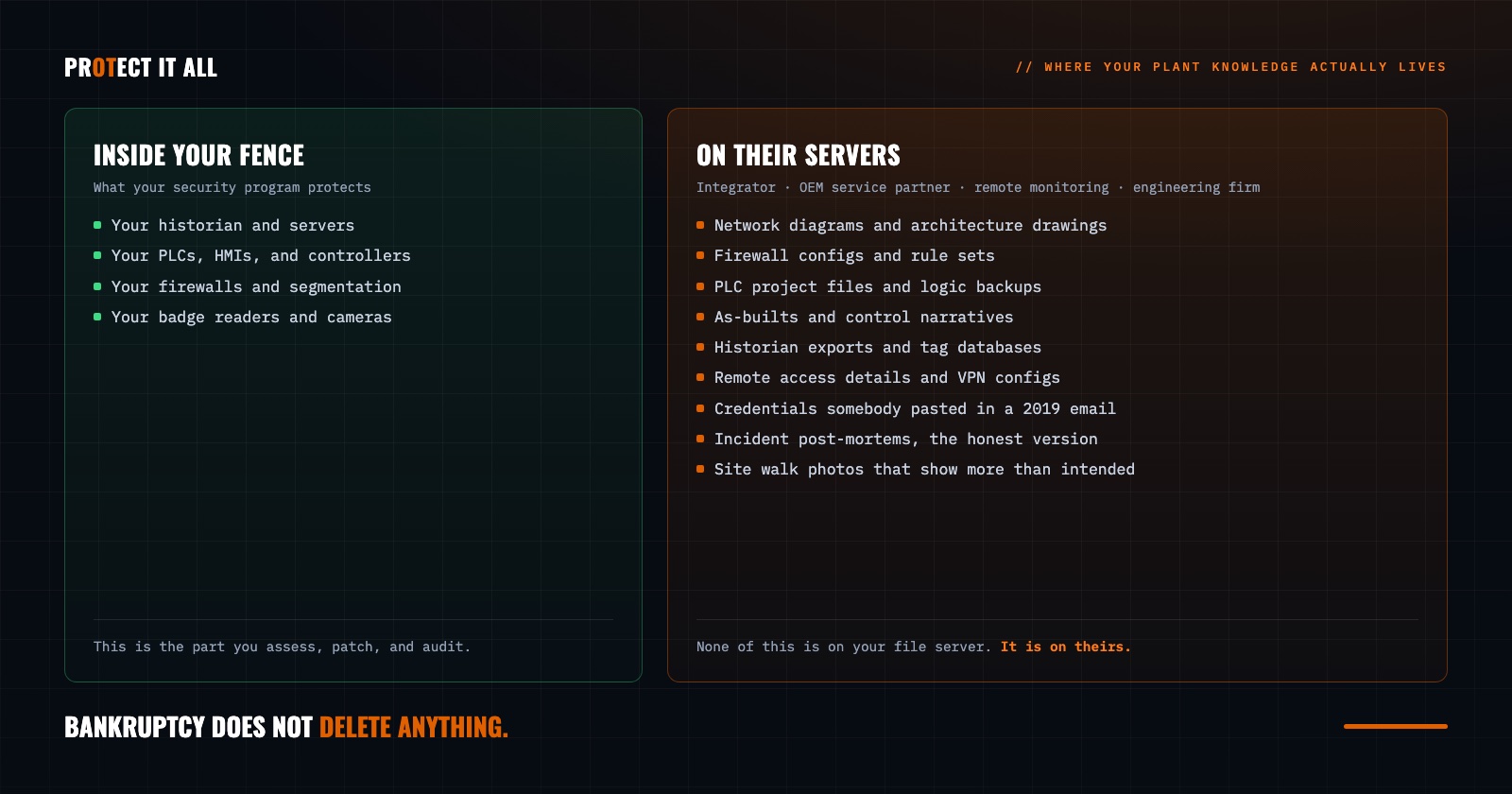
None of that is on your file server. It is on theirs.
One more thing worth saying plainly. De-identification helps people, not plants. Scrubbing PII protects individuals, and that is a real and good protection. It does nothing for operational knowledge. There is no de-identify pass for a network diagram. Redact the plant name and the diagram still teaches a stranger your architecture and where the soft center is. A hard candy network does not get harder because the label came off the wrapper.
Sort it by likelihood and impact
Risk is likelihood and impact, so do not run this against all 200 vendors on Monday.
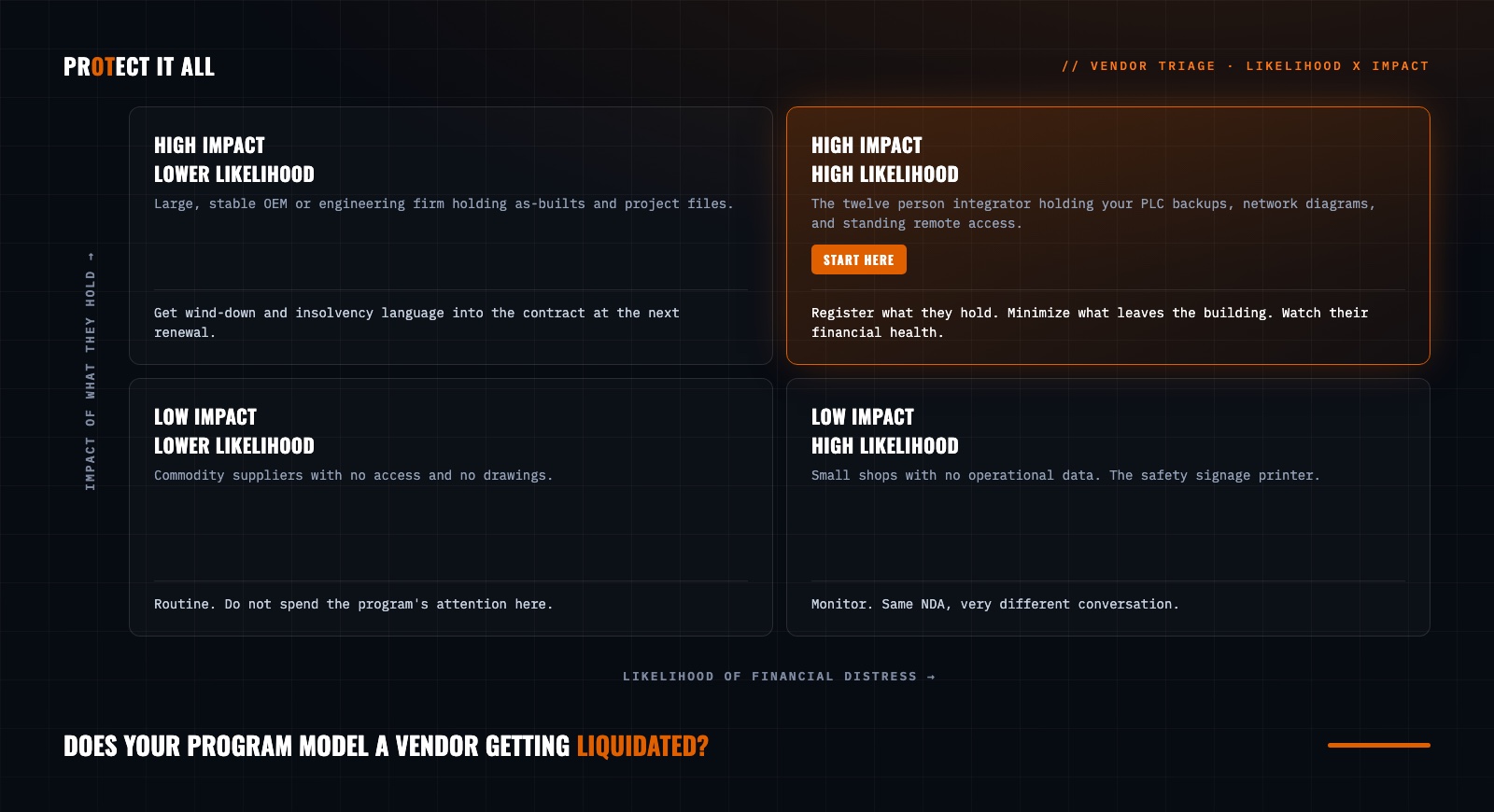
Likelihood here is financial, and it is rising. AI developers need real enterprise workflow data, supply is finite, and from here forward every Chapter 11 has a data question inside it whether anyone in the room raises it or not. The next one will not be an airline. It could be an integrator, an ICS software vendor, a managed services firm. That ecosystem runs on small and mid-size companies, and small and mid-size companies fail.
Impact is what they hold. The shop printing your safety signage and the shop holding your DCS backups are not the same conversation, even with the same NDA.
Start where both are high. That list is shorter than you expect. And ask yourself the honest version of the question: your third-party risk program models a vendor getting breached. Does it model a vendor getting liquidated?
What you can actually do about it
- Put wind-down and insolvency language in the contract. Data return or certified destruction, an explicit statement that your data does not transfer as an estate asset, escrow for critical documentation where it fits. Ask counsel what actually survives bankruptcy, because some of it may not, and that answer changes what you hand over in the first place.
- Keep a register of what each vendor holds about you. Who has project file backups. Who has current network diagrams. Who has standing remote access. Asset inventory thinking, applied to information. You cannot chase what you never tracked.
- Minimize what leaves the building. Share what the vendor needs for this job, not a standing copy of everything. Time-limited access beats emailing a config export that lives in their mailbox forever.
- Watch vendor financial health the way you watch security posture. A vendor in distress is a data event waiting for a docket number.
- If a vendor that holds your data files for bankruptcy, show up. Contact the trustee, file the objection, assert your contract rights early. Silence reads as consent.
- Ask the same question about yourselves. If you divested a plant or wound down a business unit tomorrow, where does the OT data go? Divestitures have the same dynamics and a lot less scrutiny.
Watch this one
The Spirit sale is not final. Bankruptcy Judge Sean Lane was set to rule on August 19, and the hearing got delayed after formal objections, notably from labor unions representing former Spirit employees. They raised privacy risk, the use of employee work product for AI training without meaningful consent, re-identification risk despite the de-identification promises, and the argument that employees should share in the proceeds.
The de-identification may hold up. It may not. The judge may approve the sale as filed, or the objectors may win real concessions. I do not know, and anyone who tells you they do is guessing. But notice one thing that already happened. The unions objected, and the process slowed down to hear them. Showing up worked.
We do business at the speed of trust, and most of these vendor relationships have earned it. This is not about distrusting your integrator. A company in liquidation is simply no longer the company you trusted. The people you know are gone, and the decisions belong to someone whose only job is getting creditors paid.
Fundamentals win every time. Know what you have. Know who else has it. Write down what happens to it when the other party is gone. Then go find out who has your project files.
Stay safe and secure out there. Let’s get to work, and let’s protect it all.